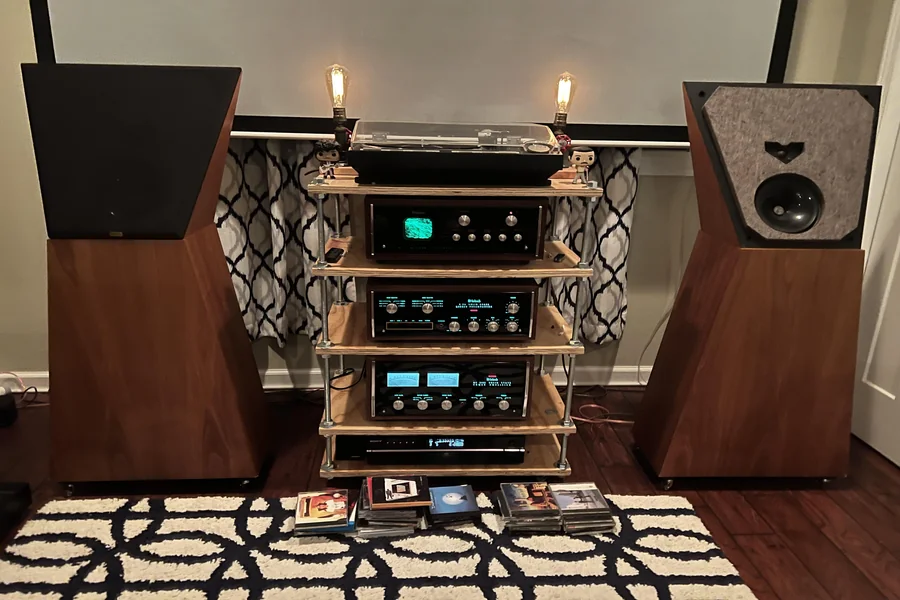
The Spica Angelus speakers are vintage, high fidelity loudspeakers that deliver a spacious stereo image, tonal balance and imaging for listeners who care. The unusual shape of the cabinet, the closed design of the enclosure and the special design of the crossover made the speaker stand out from many others at the time.
At the audio end of things, Spica Angelus speakers are also interesting as they were built with timing, dispersion and stereo imaging in mind, rather than maximum bass and extreme output. Spica Angelus speakers can be a great addition to a dedicated two channel system, vintage audio room or well matched modern system.
What Are Spica Angelus Speakers?
Two-way floorstanding loudspeakers from the late 1980s are called Spica Angelus speakers. They are powered by an 8 inch bass/midrange driver, 1″ soft dome tweeter, sealed cabinet and a crossover of 3.4kHz. They were known for their solid stereo imaging and tonal control performance, as well as the unique angled enclosure.
Spica Angelus Speakers Quick Facts
| Feature | Details |
| Type | Two-way floorstanding speaker |
| Enclosure | Sealed box |
| Woofer | 8-inch TPX-cone bass/midrange |
| Tweeter | 1-inch soft dome |
| Frequency response | 45Hz-17.5kHz (-3dB) |
| Sensitivity | 87dB/W/m |
| Nominal impedance | 8 ohms |
| Crossover | 3.4kHz |
| Amplifier range | 20-200 watts |
| Weight | About 65 lb each |
The published specifications for Spica Angelus speakers list a 46-inch height, 21-inch width, 10.25-inch depth, 8-ohm nominal impedance, and 20-200W amplifier recommendation.
What Makes Spica Angelus Speakers Different?
One of the advantages of Spica Angelus speakers is their emphasis on stereo imaging. The cabinet shape and driver placement was designed to better control diffraction and timing than a standard rectangular speaker cabinet.
Thick felt is also used around the front driver area for Spica Angelus speakers. In their review, Stereophile called the model a “uniquely-designed cabinet featuring a sloped upper baffle and asymmetric driver placement.”
Spica Angelus speakers are also memorable due to their unusual wide and angular cabinet design, which is closely related to their acoustic design.
Driver Design
Spica Angelus speakers feature two-way design with one 8″ bass/midrange driver and one 1″ soft dome tweeter. Drivers were from the Audax in a version chosen and/or altered for the design.
The tweeter is responsible for handling the high frequencies and the bass and midrange frequencies are handled by the larger driver. The simplicity of this arrangement lets Spica Angelus speakers shun the hassle of a bigger multi-driver setup.
Crossover and Time Coherence
The crossover is an important part of Spica Angelus speakers. The published crossover frequency is 3.4kHz, and the documentation in the literature describes a network created in a computer, designed to provide a time-coherent response.
For listeners this can help to create focused voices and instruments when listening position and placement are correct.
Sound Quality
Spica Angelus speakers are often associated with clarity, imaging, and openness rather than exaggerated bass.
A well-positioned pair can create a broad soundstage where vocals appear centered and instruments seem more clearly separated. Spica Angelus speakers can suit acoustic music, vocals, jazz, classical music, and other recordings where placement and detail matter.
The tonal balance can sound lean compared with larger or more bass-heavy floorstanders. Historical measurements and reviews also noted relatively light low-frequency weight despite useful extension from the sealed design.
Bass Performance
Spica Angelus speakers use a sealed enclosure rather than a bass-reflex port. The listed system resonance is 34Hz, while the rated response reaches 45Hz at -3dB.
In practical listening, Spica Angelus speakers can provide tight and controlled bass, but they are not designed to deliver modern subwoofer-style impact.
If you enjoy deep electronic bass, movie effects, or very high listening levels, Spica Angelus speakers may benefit from a carefully integrated subwoofer.
Midrange and Treble
One of the strongest areas of Spica Angelus speakers is the midrange presentation. Vocals can sound direct and well placed, while guitars, strings, and piano can benefit from the speaker’s emphasis on coherence.
The soft-dome tweeter gives Spica Angelus speakers a generally smooth upper-frequency approach, although room acoustics and listening position can change the perceived treble. Period measurements found mostly even behavior with some upper-frequency irregularities depending on angle and room interaction.
For vintage units, tweeter condition matters because aging, prior repair, or replacement parts can change how Spica Angelus speakers sound.
Sensitivity and Amplifier Matching
Spica Angelus speakers have a published sensitivity of 87dB/W/m and a nominal impedance of 8 ohms. That makes them a reasonably manageable amplifier load, although they are not especially high-sensitivity speakers.
Spica Angelus speakers were specified for amplifiers from 20 to 200 watts. In a larger room or at higher listening levels, clean amplifier power is useful.
A quality solid-state amplifier can work well, while some tube amplifiers may also be suitable because Spica Angelus speakers maintain a relatively friendly impedance curve.
Room Placement
Placement is critical with Spica Angelus speakers. Start by keeping the pair symmetrical in the room and giving them some breathing space from nearby walls. Then adjust toe-in gradually while listening to the center image.
Spica Angelus speakers can reward careful setup more than casual placement. The goal is to create a stable soundstage without making the left and right cabinets easy to identify as separate sound sources.
Listening distance also matters. If you sit too close, the drivers may not integrate as naturally. If you sit too far away in a reflective room, the imaging advantage of Spica Angelus speakers may be reduced.
Buying Used Spica Angelus Speakers
Because Spica Angelus speakers are no longer a current retail model, most buyers will find them through used-audio marketplaces, local sellers, estate sales, or specialist vintage dealers.
Before buying Spica Angelus speakers, inspect both cabinets closely and confirm that the left and right speakers have matching drivers.
Also listen for buzzing, distortion, weak tweeters, or major channel imbalance. Non-original replacement drivers may change performance.
Used Buying Checklist
Before purchasing Spica Angelus speakers, check:
- Woofer condition
- Tweeter operation
- Matching left and right drivers
- Cabinet damage
- Loose terminals
- Crossover repairs
- Unusual rattles
- Channel balance
- Seller history
- Shipping method
The cabinets are large and heavy, so shipping Spica Angelus speakers requires careful packing.
Advantages
A major advantage of Spica Angelus speakers is stereo imaging.
Spica Angelus speakers also have strong vintage appeal because of their unusual appearance and engineering history. For listeners who prioritize spatial presentation over maximum bass output, Spica Angelus speakers can still be an interesting option.
Limitations
Spica Angelus speakers are large, so they need more floor space than bookshelf speakers. They can also sound lighter in the bass than some modern towers.
Age is another limitation. Any pair of Spica Angelus speakers may have decades of use behind it, so condition can vary widely. Replacement parts are not always as simple to source as they would be for a current-production loudspeaker.
Spica Angelus Speakers vs Modern Floorstanding Speakers
Modern speakers may offer deeper bass, smaller cabinets, higher power handling, updated materials, and easier parts support.
Spica Angelus speakers compete differently. Their attraction is tied to imaging, vintage engineering, and a specific presentation rather than the newest driver technology.
A modern floorstander may be easier for everyday ownership, while Spica Angelus speakers may appeal more to enthusiasts who enjoy careful setup and classic hi-fi designs.
Final Thoughts
Spica Angelus speakers remain an interesting part of vintage American hi-fi because they combine unusual cabinet geometry, a simple two-way driver system, sealed bass loading, and a strong emphasis on stereo imaging.
The best Spica Angelus speakers are not simply the cleanest-looking pair. Driver originality, crossover condition, cabinet integrity, amplifier matching, and room placement all affect performance.
For the right listener, Spica Angelus speakers can provide a focused, spacious, and engaging two-channel experience even decades after their original release.
FAQs
Are Spica Angelus speakers still good?
Yes, the speakers can still sound very good when the drivers, crossover, cabinet, and terminals are in proper condition.
How much power do Spica Angelus speakers need?
The speakers were specified for amplifiers in the 20-200W range, with 87dB/W/m sensitivity.
Are Spica Angelus speakers bass-heavy?
No. The speakers generally emphasize controlled bass and imaging rather than heavy low-frequency impact.
Do Spica Angelus speakers need a subwoofer?
Not always, but the speakers may benefit from a subwoofer if you want deeper bass for movies, electronic music, or large-room listening.
What impedance are Spica Angelus speakers?
The speakers have a nominal impedance of 8 ohms. Published data lists a minimum around 5.8 ohms, while later measurements reported a minimum close to 5.2 ohms.
Why are Spica Angelus speakers unusual?
The speakers use a distinctive angular cabinet, felt-treated baffle, asymmetrical driver arrangement, and crossover design intended to support precise imaging and timing.