The audio system in high end cars is meant for those who seek this sort of detail, balance, power and realism from their audio system that most of the factory systems cannot offer. A special system can enhance vocals, instrument separation, bass control, soundstage and comfort in the car.
To many people who love car audio, it’s not just about making music louder. The objective is to produce clear and authentic sound through the use of quality speakers, appropriate amplification, digital signal processing, installation and system tuning.
Good planning and a high end car audio system can be a day-to-day-derivation or a fully bespoke audio quality system. This will depend on your car, your music tastes, your budget, your space and what kind of listening experience you are looking for.
What Is High End Car Audio?
High end car audio refers to a premium vehicle sound system built with better speakers, amplifiers, source equipment, subwoofers, DSP processing, wiring, acoustic treatment, and professional tuning. The main goal is to reproduce music with greater clarity, detail, bass control, imaging, and realism than a standard factory system.
High End Car Audio Quick Facts
| Feature | Details |
| Main goal | Premium sound quality and accurate playback |
| Core parts | Speakers, amplifiers, DSP, subwoofer, source |
| Installation | Factory locations or custom fabrication |
| Tuning | Crossovers, EQ, time alignment, gain settings |
| Sound treatment | Often used to reduce vibration and road noise |
| Power | Matched to speaker and subwoofer requirements |
| Best for | Enthusiasts, daily drivers, luxury audio builds |
| Main keyword | high end car audio |
Before building high end car audio, decide whether your priority is sound quality, strong bass, high output, factory-style appearance, or a combination of these goals. This decision helps determine the correct components and installation strategy.
What Makes High End Car Audio Different?
The most apparent variation between high-end car audio and regular is system integration. A lot of premium components do not make for a good sound. All of the above must work together with the speakers, amplifiers, DSP settings, subwoofer placement, electrical support, and cabin acoustics.
Another difference is attention to detail. Some of the more popular topics for high end car audio installations are speaker positioning, secure speaker mounting, door treatment, signal quality, time alignment, crossover points, and equalization.
With a carefully tuned high end car audio system, a stable front soundstage can be achieved and vocals will feel like they are right in the middle, and instruments have more distinct positions, rather than sounding directly from the doors.
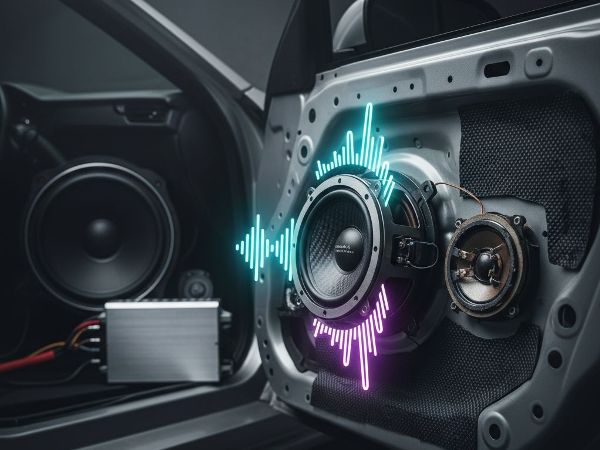
Main Components of High End Car Audio
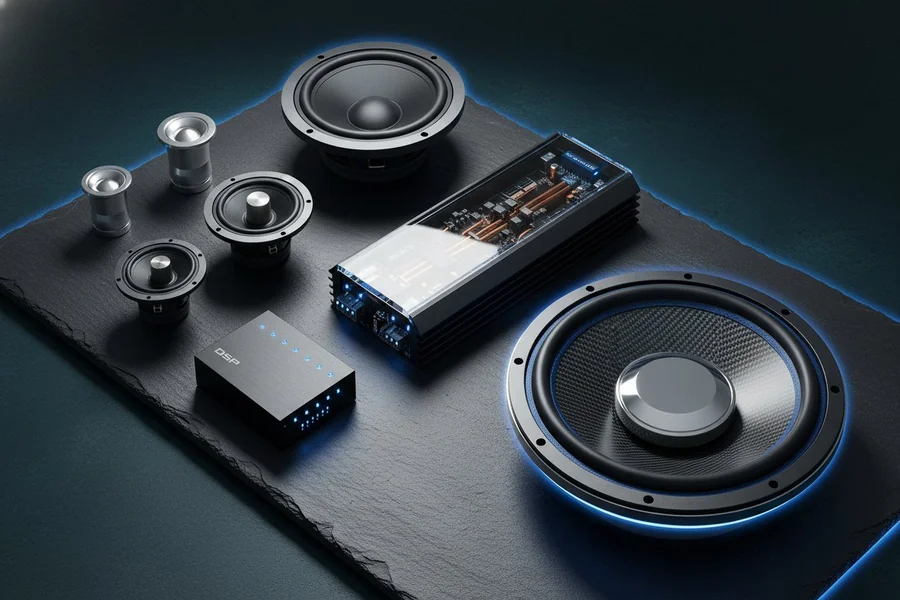
A complete high end car audio system may include several important components.
Premium Speakers
Speakers are one of the most important parts of high end car audio because they reproduce most of the audible frequency range.
Component speaker systems are common in premium builds because the woofer, midrange, and tweeter can be installed in separate positions. This gives high end car audio installers more control over soundstage and frequency coverage.
Speaker quality matters, but correct installation is equally important. A premium driver mounted poorly may perform worse than a less expensive speaker installed securely and tuned properly.
Amplifiers
Amplifiers provide clean power to the speakers and subwoofer. In high end car audio, amplifier selection should be based on RMS output, impedance compatibility, channel count, efficiency, size, and sound-system design.
A good amplifier can give high end car audio speakers better control at higher listening levels while reducing the need to push a factory radio beyond its comfortable operating range.
Multiple amplifiers may be used in complex systems, although modern multi-channel models can simplify high end car audio installations.
Digital Signal Processor
A DSP is a major tool in many high end car audio systems. It allows precise control over equalization, crossover settings, time alignment, output levels, and channel routing.
Because a vehicle interior creates reflections and unequal speaker distances, high end car audio can benefit significantly from DSP correction.
Professional tuning can use the DSP to improve center imaging, frequency balance, and integration between the front speakers and subwoofer.
Subwoofers
Subwoofers reproduce deep bass frequencies that smaller door speakers cannot handle effectively. In high end car audio, the goal is often controlled and accurate bass rather than bass that simply overwhelms the rest of the music.
A correctly designed enclosure helps a subwoofer perform properly. Sealed, ported, and custom enclosure designs can all be used in high end car audio depending on the desired sound and available space.
The subwoofer should blend with the front stage so that bass feels connected to the music instead of coming from a separate location in the trunk.
Source Unit and Signal Quality
The entire high end auto audio system may be impacted by the source signal. Some people leave the factory’s infotainment system in place, others opt to add an aftermarket receiver or a standalone digital audio source.
High end car audio processors can be used with factory source to control factory equalization, channel summing, delay and signal-level problems.
The benefit of good signal routing is to give high-end car audio components a high-quality signal prior to being amplified and tuned.
Speaker Placement and Soundstage
Speaker placement strongly affects high end car audio performance. Door speakers, dashboard locations, A-pillars, kick panels, and custom pods all create different listening results.
Tweeters are especially sensitive to positioning and angle. In high end car audio, small changes in tweeter direction can influence brightness, imaging, and soundstage height.
The objective is usually to create a front stage that feels wide, centered, and natural for the driver without making individual speakers easy to locate.
Door Treatment and Acoustic Control
Vehicle doors are not naturally ideal speaker enclosures. Thin metal, plastic trim, service openings, and vibration can reduce clarity.
High end car audio installations commonly use sound-deadening or damping materials to reduce resonance and panel vibration.
Proper treatment can improve midbass response and reduce unwanted noise, allowing high end car audio speakers to perform more consistently.
Crossovers and Frequency Management
Crossovers determine which frequencies are sent to each speaker. High end car audio systems often use active crossovers controlled by a DSP.
A tweeter can be protected from low frequencies, while a midbass driver can be prevented from reproducing deep bass that should be handled by the subwoofer.
Correct crossover points help high end car audio components operate within appropriate ranges and make it easier to blend different drivers smoothly.
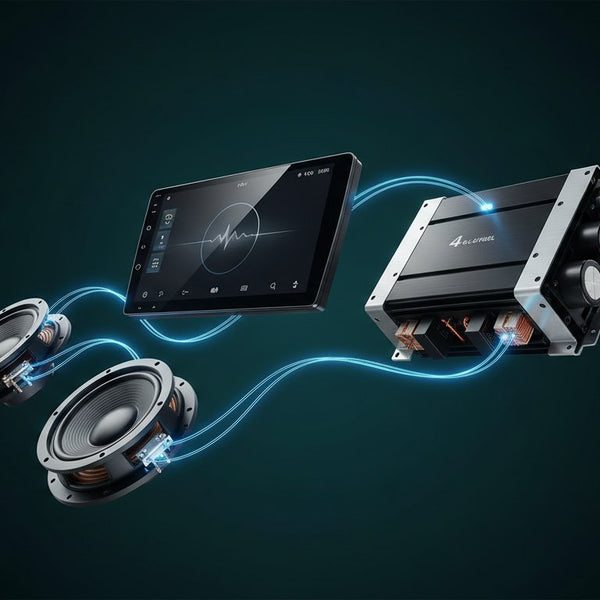
Time Alignment
The driver sits closer to some speakers than others, so sound reaches each ear at slightly different times.
Time alignment is commonly used in high end car audio to delay closer speakers so that sound from multiple locations reaches the listener more coherently.
When adjusted carefully, high end car audio can create stronger center imaging and a more realistic sense of depth across the dashboard.
Equalization
Equalization helps correct peaks and dips caused by the vehicle interior, speaker placement, and reflections.
In high end car audio, EQ should usually be used after basic installation, polarity, crossover, and level settings are correct.
Excessive EQ can reduce headroom or create unnatural sound. The best high end car audio tuning normally uses measured adjustments combined with careful listening.
Power Handling and RMS Ratings
Power matching is essential when selecting amplifiers and speakers for high end car audio.
RMS ratings are generally more useful than peak-power numbers because they better represent continuous operating capability.
For reliable high end car audio, amplifier output should be matched sensibly to the speakers and subwoofer while leaving room for clean dynamic peaks.
Impedance
Speaker impedance affects how much electrical load the amplifier sees.
High end car audio systems may use different driver impedances depending on amplifier design and wiring configuration.
Always calculate final impedance before wiring multiple drivers because an unsafe load can cause overheating, protection shutdown, distortion, or equipment damage.
Wiring and Electrical Support
Good wiring supports safe and reliable high end car audio operation.
Power cables, grounds, fuses, speaker wire, RCA cables, and digital connections should be correctly sized and routed.
Larger high end car audio systems may require stronger battery support, improved grounding, or charging-system upgrades, especially when several powerful amplifiers are used.
Factory Integration
Modern vehicles often combine the stereo with navigation, climate controls, warning sounds, cameras, and vehicle settings.
For this reason, high end car audio upgrades frequently keep the original head unit and add integration hardware behind it.
A proper interface allows high end car audio improvements without unnecessarily removing important factory features.
Sound Quality vs Loudness
High volume and high sound quality are not the same thing.
High end car audio usually emphasizes low distortion, accurate tonal balance, controlled bass, stable imaging, and musical detail.
A system can be very loud without meeting high end car audio goals if it produces harsh treble, boomy bass, weak imaging, or obvious distortion.
Best Uses
A high end car audio system can be suitable for:
- Premium daily-driver upgrades
- Luxury vehicle sound improvements
- Sound-quality competition builds
- Custom show vehicles
- Long-distance listening
- Detailed music playback
- Strong but controlled bass systems
- Factory-integrated premium systems
- Multi-way active speaker setups
- Enthusiast audio projects
The right high end car audio design depends on available space, listening preferences, installation complexity, and the amount of factory equipment that must be retained.
Advantages
One major advantage of high end car audio is improved clarity. Better speakers and careful tuning can reveal details that may be difficult to hear through basic factory systems.
Another benefit is customization. High end car audio can be tuned around the driver, the vehicle cabin, the preferred music style, and the desired bass level.
A properly installed high end car audio system can also provide better performance at moderate volume, so enjoying premium sound does not always require loud listening.
Limitations
High end car audio can become expensive because the total cost includes components, installation, fabrication, wiring, acoustic treatment, tuning, and sometimes electrical upgrades.
It can also require more installation time than a simple speaker replacement.
Another limitation is that high end car audio results depend heavily on tuning. Expensive equipment installed without proper setup may not deliver the expected improvement.
High End Car Audio vs Factory Premium Systems
Some modern vehicles already include branded factory premium audio packages with multiple speakers, dedicated amplifiers, and digital processing.
Aftermarket high end car audio usually offers more flexibility because individual components, crossover points, amplifier power, speaker positions, and DSP settings can be customized.
However, factory systems may provide better integration and convenience. The best path depends on how much modification you want and whether the original system already meets your expectations.
High End Car Audio vs Basic Aftermarket Upgrades
A basic aftermarket upgrade may involve replacing the door speakers or adding a small amplifier.
High end car audio goes further by treating the sound system as a complete chain from source to speakers.
Instead of focusing on one component, high end car audio considers signal processing, acoustic treatment, power delivery, placement, crossover design, tuning, and subwoofer integration together.
Is a DSP Necessary?
A DSP is not mandatory for every audio system, but it is extremely useful for many premium builds.
High end car audio benefits from DSP because the vehicle cabin creates difficult acoustic conditions that cannot always be solved through speaker quality alone.
If the goal is accurate imaging and balanced response, a DSP can make high end car audio easier to tune precisely.
Is Sound Deadening Worth It?
Sound treatment can be valuable when road noise, door vibration, or panel resonance is affecting the listening experience.
In high end car audio, damping the doors can improve the working environment for midbass speakers and reduce unwanted rattles.
It does not replace quality speakers or tuning, but sound treatment can help premium car audio perform more consistently.
Who Should Build a Premium System?
Premium car audio is suitable for listeners who spend significant time in their vehicles and care about sound quality, detail, imaging, and controlled bass.
It can also make sense for enthusiasts who enjoy customizing audio equipment and tuning.
Drivers who only want slightly more volume may not need a complete premium car audio build and may be satisfied with a smaller upgrade.
Buying Checklist
Before buying premium car audio equipment, check:
- Vehicle speaker sizes and mounting depth
- Factory head-unit features
- Speaker RMS ratings
- Amplifier RMS output
- Speaker impedance
- DSP inputs and outputs
- Number of amplifier channels
- Subwoofer enclosure space
- Wiring and fuse requirements
- Battery and charging capacity
- Sound-deadening needs
- Installation and fabrication costs
- Tuning availability
- Warranty coverage
- Your preferred sound signature
This checklist helps make premium car audio planning more organized and prevents buying parts that do not work well together.
Installation Tips
Start by creating a system plan instead of purchasing components randomly.
For premium car audio, determine how many speaker channels you need, where each driver will be mounted, how the DSP will route signals, and how much amplifier power is required.
Use secure mounting, correct polarity, protected wiring, proper fusing, and solid grounding. These details help premium car audio remain reliable over time.
Tuning Tips
Begin with safe crossover points and conservative amplifier gains.
Next, adjust speaker levels and time alignment before making aggressive EQ changes.
Premium car audio tuning is often easier when measurements are used to identify major frequency problems, followed by listening tests to refine the final result.
Do not chase a perfectly flat measurement if the system sounds unnatural. The purpose of premium car audio is enjoyable and accurate music reproduction inside the actual vehicle.
Final Thoughts
Premium car audio combines premium components with thoughtful installation and precise tuning to create a more detailed and immersive vehicle listening experience.
The strongest premium car audio systems are built as complete systems rather than collections of expensive parts. Speaker placement, amplification, DSP settings, acoustic treatment, wiring, and subwoofer integration all matter.
Before spending heavily, define your listening goals and build around them. A carefully planned premium car audio system can provide excellent clarity, realistic imaging, controlled bass, and enjoyable everyday performance.
FAQs
What does premium car audio mean?
Premium car audio means a premium vehicle sound system designed around better components, careful installation, accurate tuning, and improved sound quality.
What components are needed for premium car audio?
A typical premium car audio setup can include component speakers, amplifiers, a DSP, a subwoofer, quality wiring, sound treatment, and a suitable source signal.
Does premium car audio need a DSP?
Not always, but a DSP gives premium car audio much greater control over crossovers, EQ, time alignment, and channel levels.
Is premium car audio only about loud bass?
No. Premium car audio usually focuses on clarity, imaging, tonal balance, controlled bass, low distortion, and realistic music reproduction.
Can I keep my factory radio?
Yes. Many premium car audio systems retain the factory radio and use integration equipment or a DSP to connect aftermarket amplifiers and speakers.
How much power does premium car audio need?
Power requirements vary by system. Premium car audio should use amplifier RMS output that matches the speakers and subwoofer without relying on exaggerated peak ratings.
Is sound deadening important?
It can be very helpful. Premium car audio often benefits from door and panel treatment because it reduces vibration, resonance, and road-noise interference.
Can premium car audio work in a daily driver?
Yes. Premium car audio can be designed for normal daily use while keeping factory controls, cargo space, and a clean interior appearance.
Should I install premium car audio myself?
Experienced enthusiasts can handle some installations, but complex premium car audio builds involving DSP tuning, fabrication, electrical upgrades, and factory integration may benefit from professional installation.
What should I check before buying?
For premium car audio, check fitment, RMS power, impedance, amplifier channels, DSP capability, enclosure space, electrical needs, installation cost, and tuning requirements.