The vandersteen speakers series is designed for listeners who value stereo imaging, musical presentation, driver integration and system building over the long term. The company has been making loudspeakers for decades, and their current line features models that are easy to use and appreciate, even as well as their cutting-edge reference designs.
Vandersteen loudspeakers have a reputation for being good examples of the brand’s focus on time- and phase-correct performance, first-order crossover ideas and controlled driver placement among many consumers. The design decisions are made to maintain music sequence and provide a solid stereo image.
The most appropriate vandersteen speakers for one listener may not be for another. There are factors to consider such as room size, amplifier power, listening distance, desired bass extension, placement flexibility and budget.
Featured Answer: What Are Vandersteen Speakers?
Vandersteen loudspeakers are high-fidelity loudspeakers made by Vandersteen Audio in the United States. The range includes models such as the Model 1Ci+, Model 2Ce Signature III, Model 3A Signature, Treo CT, Quatro Wood CT, and KĒNTO Carbon, with an emphasis on time- and phase-aligned reproduction.
Vandersteen Speakers Quick Facts
| Feature | Details |
| Brand | Vandersteen Audio |
| Main category | High-fidelity loudspeakers |
| Popular series | Model 1, Model 2, Model 3, Treo, Quatro, KĒNTO |
| Design focus | Time and phase accuracy |
| Typical use | Two-channel music, premium stereo, home theater |
| Manufacturing | USA |
| Entry reference | Model 1Ci+ |
| Long-running classic | Model 2 series |
| Main keyword | vandersteen speakers |
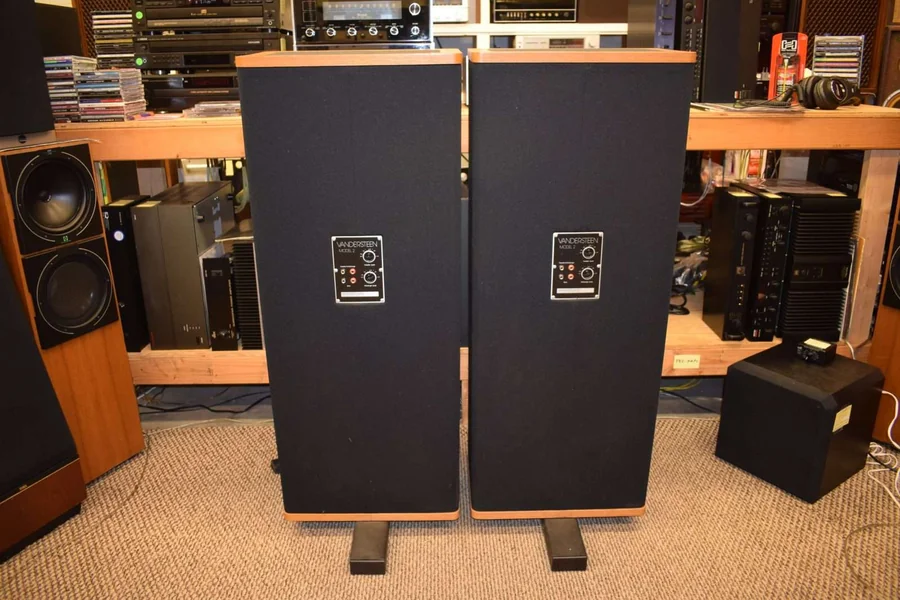
One of the best-known vandersteen speakers is the Model 2Ce Signature III. Vandersteen says the Model 2 line has been in continuous production since 1977 and that more than 100,000 pairs of Model 2 speakers have been sold. The current 2Ce Signature III is listed with a 1-inch tweeter, 4.5-inch midrange, 8-inch woofer, and 10-inch active acoustic coupler.
What Makes Vandersteen Speakers Different?
One of the main concepts behind Vandersteen loudspeakers is time and phase integrity in the loudspeaker system. It says it is time- and phase-correct, and that it features minimum area baffles to minimize diffraction effects.
This does not imply that vandersteen speakers are built only for a specific frequency response figure or to get the loudest possible. The system approach involves a selection of drivers, crossover behaviour, listeneraxis setup, physical positioning of drivers in the cabinet and cabinet geometry.
Another trait of Vandersteen loudspeakers is that a lot are designed to be placed and tilted very carefully to the listening seat. This is especially vital to consider when setting up, as it is more than just placing the cabinets against a wall and turning up the volume.
Model 1Ci+: Starting Point in the Range
The Model 1 series has long been an entry into vandersteen speakers for the masses. Vandersteen says the Model 1 series has been in full production since 1983, and the 1Ci+ is a scaled down version of the loudspeaker line.
The Model 1Ci+ is a good choice for a listener who wants to create their first serious stereo system, but who is not looking for the bass scale or output of a larger model of the Vandersteen.
The Model 1 family is also characterized by a number of design ideas common to vandersteen speakers, including a focus on music over flashy cosmetic details, stereo imaging and phase-conscious design.
Model 2Ce Signature III
One of the most famous Vandersteen loudspeakers is the Model 2Ce Signature III. It is a continuation of the Model 2 line which started in 1977 and still forms a vital part of the company’s product line.
According to the official specification, the vandersteen speakers Model 2Ce Signature III have a frequency response of ±3 dB from 29Hz to 29KHz, sensitivity of 86 dB at 1 meter and 2.83 volts, and nominal impedance of 7 ohm and minimum impedance of 4 ohm.
The recommended power for these Vandersteen loudspeakers is 40 – 160 watts into 8 Ohm. The cabinet is approximately 16″ wide, 39.75″ high and 10.25″ deep with each speaker weighing approximately 60 lbs.
If a buyer is looking at a classic full-range speaker design but doesn’t necessarily want to venture into the company’s much more expensive reference line, vandersteen speakers in the Model 2 series may come to mind.
Model 3A Signature
The Model 3A Signature takes Vandersteen loudspeakers to a new scale and system level. Vandersteen puts it right above the Model 2 lineup and says it features “high quality crossover components and hand tuned compensation networks.
Because of its larger size, vandersteen speakers such as the Model 3A Signature are better suited to listeners who can provide adequate room space and appropriate amplification.
The Model 3A Signature also shows how Vandersteen loudspeakers are designed to be a progression. A customer may upgrade from the smaller Model 1 series to the Model 2, and then to the Model 3 or 4 series as space, budget, and system desires grow.
Treo CT
The Treo CT is a slimmer and more understated floorstanding speaker, introducing vandersteen’s speakers into the new package. Vandersteen calls it a three-way speaker with “full range” coverage with the inclusion of the company’s carbon-fiber Perfect-Piston Carbon Tweeter.
The Treo CT is intended to be used relatively close to the back wall as opposed to larger Vandersteen loudspeakers. This can make it appealing in living rooms, where loudspeakers aren’t necessarily going to be able to be placed a long way back in the room.
If listeners are seeking a design that shares the brand’s essence, but also looks more like a traditional vandersteen speaker, the Treo CT is a significant option to consider.
Quatro Wood CT
The Quatro Wood CT is a significant leap forward in Vandersteen’s line of loudspeakers. It’s a combination of a high quality multiway loudspeaker design with powered bass and room control system settings.
The built-in low frequency system differentiates vandersteen speakers like the Quatro Wood CT from the passive floorstanders by treating the bass performance in a different way. The speaker can be integrated more carefully with the room when properly set up.
The Quatro range is targeted at listeners who wish to enjoy Vandersteen’s loudspeakers with deep bass, high resolution and large scale stereo reproduction without the need of a full scale conventional subwoofer setup.
KĒNTO Carbon
The KĒNTO Carbon is on a different level in the vandersteen speaker pecking order. The model features technology such as its carbon tweeter, carbon/balsa-core midrange and side-firing, powered 9-inch bass drivers, says Vandersteen.
Official pricing also proves Vandersteen loudspeakers can be a wide range in price. The KĒNTO Carbon is on offer to start at $47,000 per pair, ex tax, freight and duties.
Vandersteen speakers like the KĒNTO Carbon are designed for the listening room enthusiast who regards source quality, amplification, room treatment, speaker placement and speaker set up as significant components of the listening experience.
Sound Character and Listening Experience
The sound from Vandersteen loudspeakers is generally recognized to be coherent, well-balanced and more musical than overly treble or bass-heavy.
The relationships of left to right location and front to back depth can be well established through vandersteen speakers when positioned properly.Left to right location and front to back depth can be well established with vandersteen speakers when positioned properly. This will largely be dependent on the recording, amplifier, room acoustics, speaker spacing and listening position.
Many Vandersteens loudspeakers are built with a time and phase sensitive philosophy in mind, so there is a relationship between setup geometry and the loudspeaker.
Amplifier Matching
Amplifier selection is important with vandersteen speakers because different models vary in sensitivity, impedance, room-filling capability, and recommended power.
For example, Vandersteen specifies 40 to 160 watts into 8 ohms for the Model 2Ce Signature III. Owners of other Vandersteen loudspeakers should check the manual for the exact model rather than assuming the same amplifier recommendation applies across the line.
A stable, low-noise amplifier with appropriate current delivery can help vandersteen speakers perform consistently, especially at higher listening levels or in larger rooms.
Speaker Placement
Placement is one of the most important parts of owning Vandersteen loudspeakers. Start by keeping the pair symmetrical relative to the main listening seat when the room allows it.
Give vandersteen speakers enough space to develop a stereo image and avoid placing one cabinet much closer to a side wall than the other unless room conditions require it.
Many Vandersteen loudspeakers also benefit from precise model-specific setup and tilt adjustment. The owner’s manual for the specific speaker should therefore be followed closely.
Setup Guide
Setting up vandersteen speakers should be done methodically:
- Place the left and right speakers symmetrically.
- Measure the distance to the main listening position.
- Follow the model-specific tilt or stand instructions.
- Connect speaker cables with correct polarity.
- Confirm amplifier compatibility.
- Start at moderate volume.
- Use familiar recordings to adjust placement.
- Make small changes rather than moving the speakers dramatically.
After the basic setup, Vandersteen loudspeakers may improve further with careful attention to wall distance, listening height, toe-in, and room reflections.
Using Vandersteen Speakers for Vinyl
Many music lovers pair vandersteen speakers with turntables because the brand’s stereo-focused design suits two-channel listening.
A vinyl system built around Vandersteen loudspeakers still needs the correct phono stage, preamplifier, amplifier, and cartridge setup. The speakers themselves do not replace those components.
For best results, vandersteen speakers should be placed where turntable vibration is minimized and where the stereo pair can create a centered image without excessive bass reinforcement from nearby corners.
Using Them for Digital Music
Modern streamers, DACs, CD players, and computers can all be used with Vandersteen loudspeakers through a suitable amplifier or integrated amplifier.
The speakers are largely conventional hi-fi loudspeakers rather than all-in-one smart products, so vandersteen speakers normally rely on the rest of the system for Bluetooth, Wi-Fi, streaming apps, HDMI, or USB audio.
That separation can be an advantage for buyers who want Vandersteen loudspeakers to remain useful while source electronics are upgraded over time.
Home Theater Use
Although the brand is strongly associated with two-channel listening, vandersteen speakers can also be used in a home theater system.
Vandersteen offers dedicated center-channel products such as the VCC-1, VCC-2, and VCC-5, allowing Vandersteen loudspeakers to be integrated into a multichannel system.
For movie use, vandersteen speakers can provide a wide front soundstage, but the exact system should be selected around room size, center-channel needs, surround placement, bass management, and amplifier channels.
Advantages
A major advantage of Vandersteen loudspeakers is the company’s long-term focus on a consistent design philosophy rather than constantly changing direction.
Another strength of vandersteen speakers is the depth of the product range. Buyers can start with a relatively accessible model and move toward much more advanced systems while staying within the same overall engineering approach.
The availability of center channels, subwoofers, manuals, and model-specific setup guidance also makes Vandersteen loudspeakers suitable for users who want to build a complete system over time.
Limitations
The main limitation of vandersteen speakers is that they can demand more setup attention than casual plug-and-play speakers. Placement, tilt, amplification, and room interaction matter.
Some Vandersteen loudspeakers also use styling that prioritizes acoustic design over modern minimalist trends. Buyers who want wireless all-in-one cabinets, built-in streaming, or app-based operation may prefer a different category.
Higher-end vandersteen speakers can also become expensive quickly, especially when the system includes premium amplification, source components, cables, stands, and professional setup.
Vandersteen Speakers vs Powered Speakers
Most Vandersteen loudspeakers are designed to be used with separate amplification, while powered speakers place amplifiers inside the speaker cabinet.
That means vandersteen speakers give the owner more freedom to choose and upgrade amplification. Powered speakers can be simpler when minimizing the number of components is the main goal.
For enthusiasts who enjoy matching electronics and building a system gradually, Vandersteen loudspeakers may offer greater long-term flexibility.
Vandersteen Speakers vs Conventional Passive Floorstanders
Compared with many conventional floorstanders, vandersteen speakers place unusual emphasis on time alignment, phase behavior, and physical driver geometry.
That does not mean every listener will automatically prefer Vandersteen loudspeakers. Sound preference remains personal, and room acoustics can influence the result as much as the speaker’s design approach.
The most useful comparison is to audition vandersteen speakers against similarly priced alternatives using familiar music and similar electronics.
Who Should Buy Them?
Vandersteen loudspeakers are well suited to listeners who value two-channel music, imaging, natural tonal balance, system upgradeability, and careful setup.
They also make sense for buyers who want vandersteen speakers from a brand with a long-running product history and a clear design philosophy.
If you enjoy adjusting speaker position and building a system around separate components, Vandersteen loudspeakers can suit that style of ownership.
Who May Want Something Else?
Buyers who want a portable speaker, battery power, built-in voice assistants, simple Bluetooth-only operation, or a one-box streaming system may find vandersteen speakers more complex than necessary.
Listeners with extremely limited placement options should also check whether the specific Vandersteen loudspeakers model can work with the available wall distance and room geometry.
Before buying, auditioning vandersteen speakers is useful because tonal preference, listening distance, room behavior, and amplifier pairing can change the experience significantly.
Buying Checklist
Before ordering Vandersteen loudspeakers, check the following:
- Your room is large enough for the model.
- Your amplifier is compatible with the speaker load.
- You can follow the recommended placement and tilt.
- You have appropriate stands if the model requires them.
- Speaker cables can reach without strain.
- Your listening seat is reasonably stable.
- Your source and amplification quality match the system.
- You have considered bass needs and possible subwoofer integration.
- You have access to a dealer or setup help if required.
This checklist can help ensure vandersteen speakers are matched to the room and system rather than chosen only by model reputation.
Final Thoughts
Vandersteen loudspeakers cover a wide range of serious hi-fi needs, from the long-running Model 1 and Model 2 families to premium Treo, Quatro, and KĒNTO designs.
The central appeal of vandersteen speakers is not a single specification. It is the combination of time- and phase-focused engineering, careful driver integration, stereo imaging, upgradeable system design, and decades of product continuity.
For listeners willing to spend time on placement and system matching, Vandersteen loudspeakers can form the foundation of a dedicated music system that can be refined for years.
FAQs
Are Vandersteen speakers made in the USA?
Yes. vandersteen speakers are manufactured in the United States, and Vandersteen identifies the Model 2Ce Signature III as made in the USA.
What is the most famous Vandersteen model?
The Model 2 series is one of the best-known Vandersteen loudspeaker families. Vandersteen says it has been in continuous production since 1977 and that more than 100,000 pairs have been sold.
Do Vandersteen speakers need an amplifier?
Most vandersteen speakers are passive loudspeakers and require suitable external amplification, although some higher-end models include powered bass sections.
Are Vandersteen speakers good for vinyl?
Yes. Vandersteen loudspeakers can work well in a vinyl-focused stereo system when they are paired with a suitable turntable, phono stage, preamplifier, and amplifier.
Are Vandersteen speakers difficult to set up?
They are not necessarily difficult, but vandersteen speakers can reward more careful placement and model-specific setup than many casual loudspeakers.
Which Vandersteen speaker is good for beginners?
The Model 1Ci+ is positioned as an entry point into Vandersteen loudspeakers, while the Model 2Ce Signature III is a larger and more established step-up model.
Are Vandersteen speakers good for home theater?
Yes. vandersteen speakers can be used in home theater, and the company offers center-channel models such as the VCC-1, VCC-2, and VCC-5 for multichannel systems.
How much amplifier power does the Model 2Ce Signature III need?
Vandersteen recommends 40 to 160 watts into 8 ohms for this model, making Vandersteen loudspeakers in the Model 2Ce Signature III range compatible with many appropriately specified integrated amplifiers and power amplifiers.
Do Vandersteen speakers have built-in Bluetooth?
Most vandersteen speakers are traditional hi-fi loudspeakers rather than wireless smart speakers, so Bluetooth or streaming usually comes from an external source component or amplifier.
Are Vandersteen speakers worth auditioning?
For buyers interested in imaging, stereo depth, time alignment, and traditional high-fidelity system building, Vandersteen loudspeakers are worth hearing in a properly set-up room before making a purchase decision.