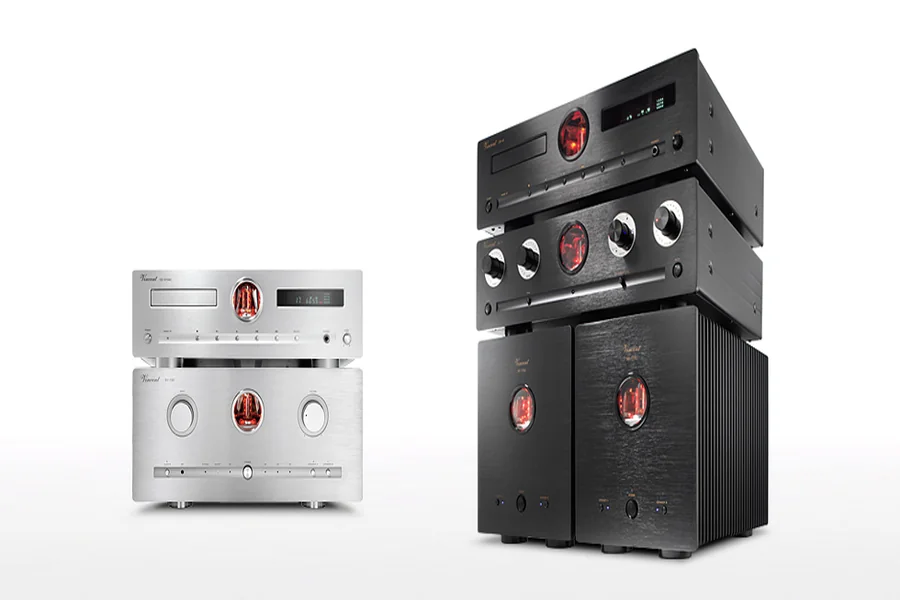
Vincent Audio is a hi-fi company that specializes in stereo amplifiers, frequently with a combination of tube and solid state technology. Products include integrated amplifiers, preamplifiers, power amplifiers and phono equipment for two channel listeners.
Vincent Audio might be bought by music enthusiasts who prefer a classic stereo system, whether they’re looking for an enclosed system or a more powerful stereo apart. The choice of product is generally dependent on the speaker impedance, room size, listening level, source equipment, connectivity and whether you are looking for an integrated amplifier or individual parts.
Many people are drawn to the options of hybrid and Class-A designs at various power levels at Vincent Audio. There are some models that specialise in analog listening, and others with digital inputs, Bluetooth, network capabilities or HDMI ARC.
Featured Answer: What Is Vincent Audio?
Vincent Audio is a hi-fi electronics brand offering integrated amplifiers, preamps, power amplifiers, phono stages, and related stereo equipment. Many Vincent Audio products use hybrid designs that combine tubes in part of the signal path with transistor amplification, aiming to blend tube-based circuitry with solid-state power and speaker control.
Vincent Audio Quick Facts
| Feature | Details |
| Main focus | Two-channel hi-fi electronics |
| Common products | Integrated amps, preamps, power amps, phono stages |
| Design options | Hybrid, tube-based stages, solid-state, Class-A |
| Typical use | Home stereo and dedicated listening rooms |
| Connectivity | Analog plus digital options on selected models |
| Speaker matching | Depends on power, impedance, and sensitivity |
| Main goal | Strong stereo performance and flexible system building |
| Main keyword | vincent audio |
Before buying Vincent Audio, check the exact model specifications because power output, inputs, tube configuration, dimensions, and connectivity can vary significantly across the range.
What Makes Vincent Audio Popular?
Vincent Audio’s commitment to hybrid amplifier design is one of the things which sets it apart from other Hi-Fi manufacturers. For the preamplifier stage, several models are based on vacuum tubes and output stages are made of transistors.
With this method, Vincent Audio will continue to deliver some of the desirable characteristics of tubes, and even some of the excitement, while maintaining the contemporary sound delivery found in solid state amplification.
Product variety is another attractiveness of Vincent Audio. They range from integrated amplifiers to high-output models, preamps to mono-block amplifiers, and phono stages and more.
Types of Vincent Audio Products
There are several categories of Vincent Audio equipment, and each one serves a different role in a stereo system.
Integrated Amplifiers
Integrated Vincent Audio amplifiers are preamp/power packages into a single enclosure. This is very useful if you want to save space on your desk by having no preamp/power amp stand.
Current examples include models such as the SV-200, SV-228, SV-237MKII, SV-500 series, SV-600, SV-700, and SV-737 family.
To many of the users, an integrated Vincent Audio amplifier is the simplest way into the brand as it eliminates the cable clutter and ease the system complexity.
Preamplifiers
A preamp by Vincent Audio selects the audio source, controls the volume and prepares the signal for output to a separate power amplifier.
Examples of this type of model include tube and hybrid models. A separate Vincent Audio preamp is appropriate if more flexibility is desired, to make for easier future upgrades or dedicated power amplifiers.
Power Amplifiers
A Vincent Audio power amplifier is an amplifier that serves to drive speakers when powered by a preamp.
The company has a selection of power amplifiers for both stereo and mono applications. If you combine a pair of Vincent Audio power amp and preamp, you can build a more modular system than a single integrated amp.
Phono Preamplifiers
Vinyl owners can also buy Vincent Audio phono stages to plug into a line-level amplifier input to connect a turntable cart.
If your main amp doesn’t have an appropriate phono input or if you’d like even more flexibility in cartridge matching, you might want to use a dedicated Vincent Audio phono preamplifier.
Hybrid Amplifier Design
One of the most well-known features of the Vincent Audio brand is its hybrid amplification technology.
A hybrid Vincent Audio design will include tubes in the preamp or input stage, and transistors in the power-output stage. Buyers need not expect any two hybrid amplifiers to be the same circuit; the circuit depends on the model.
The primary feature of the Vincent Audio approach is trying to combine the tube signal handling with the power, damping and speaker control of solid state output devices.
Class-A Operation
Some Vincent Audio amplifiers include Class-A operation for part of their rated output.
For example, certain models can deliver an initial portion of their power in Class A before transitioning to another operating mode as output demand increases.
Class-A Vincent Audio products may run warmer and consume more electricity than simpler designs, so ventilation and placement are important.
Sound Character
The final sound of Vincent Audio equipment depends on the model, speakers, source, room acoustics, and setup.
Hybrid Vincent Audio amplifiers are often chosen by listeners interested in tube-based circuitry combined with the control of transistor amplification.
However, it is better to judge Vincent Audio by a specific model than by a single brand-wide sound description. Different amplifiers use different circuits, power supplies, tubes, and output stages.
Power Output
Power output is an important specification when choosing Vincent Audio equipment.
Smaller Vincent Audio integrated amplifiers may be suitable for efficient speakers and moderate rooms, while larger models provide substantially higher output for bigger spaces or more demanding speakers.
For example, official specifications for the SV-737MK list 180 watts per channel into 8 ohms and 300 watts per channel into 4 ohms. The compact SV-200 is rated at 25 watts per channel into 8 ohms and 35 watts into 4 ohms.
Do not choose Vincent Audio only by the largest wattage number. Speaker sensitivity, impedance behavior, room size, listening distance, and preferred volume all matter.
Speaker Matching
Correct speaker matching helps Vincent Audio perform as intended.
Check the nominal impedance and sensitivity of your speakers, then compare them with the amplifier’s rated output and load capability.
A powerful Vincent Audio amplifier may be useful with low-sensitivity speakers, but very efficient speakers may need far less wattage for normal listening.
Whenever possible, audition Vincent Audio with speakers similar to the ones you own because tonal balance and system synergy can be more important than specifications alone.
Digital Connectivity
Some Vincent Audio models include digital inputs for modern sources.
Depending on the amplifier, Vincent Audio connectivity may include optical, coaxial, Bluetooth, network playback, or other digital features.
The SV-737MK adds HDMI ARC, allowing Vincent Audio to fit more easily into systems where a television is also used as a source. Its official specifications also list Bluetooth, optical, coaxial, RCA, pre-out, and speaker connections.
Before buying, check whether the Vincent Audio model includes the exact inputs you need rather than assuming all models offer the same digital features.
Analog Connectivity
Traditional analog connections remain important across much of the Vincent Audio range.
RCA inputs are common, and some higher-end Vincent Audio models also provide balanced XLR connections.
If you use a DAC, CD player, streamer, tuner, or external phono stage, confirm how many analog inputs the Vincent Audio amplifier provides.
Users building more complex systems should also check for pre-out, rec-out, main-in, trigger, or power-control connections where relevant.
Using Vincent Audio With a Turntable
A turntable can work well in a Vincent Audio system, but the required setup depends on the cartridge and amplifier.
If your amplifier does not have the phono input required by your turntable, a separate phono preamplifier can be placed between the turntable and a normal line-level input.
The company’s current product categories include dedicated phono preamplifiers alongside its main amplifier range.
Always confirm whether your cartridge is moving magnet or moving coil and whether the selected phono stage supports it.
Using It With a Streamer
A network streamer can be connected through analog or digital outputs, depending on the equipment.
If the streamer has its own DAC, simply connect its analog output to a suitable line-level input.
If you prefer a DAC built into the amplifier, optical or coaxial connections may be available on compatible models.
This flexibility makes it possible to combine traditional hi-fi amplification with modern streaming services without replacing the entire stereo system.
Placement and Ventilation
Proper ventilation is important for hi-fi amplifiers, particularly larger models and designs that operate partly in Class A.
Do not place an amplifier in a tightly sealed cabinet. Heat needs enough space to escape through the ventilation openings.
Leave space above and around the chassis and follow the installation requirements provided in the owner’s manual.
Large models can also be heavy. For example, the SV-700 is listed at 24.2 kg, while the SV-737MK weighs 21 kg. A strong equipment rack is therefore important for these components.
Tubes and Maintenance
Some products in the lineup use vacuum tubes, which means owners should understand basic tube maintenance.
Tubes can operate for many hours but are still components that may eventually require replacement.
If an amplifier begins developing unusual noise, channel imbalance, or other performance problems, professional inspection may be appropriate.
Always use compatible tube types recommended for the exact model. Installing an unsuitable replacement can create performance or reliability problems.
Dust should also be removed carefully while ventilation openings should remain unobstructed.
Build and System Design
Many models use substantial chassis designs and power supplies designed for dedicated stereo use.
Higher-output equipment can be physically large and heavy, so checking dimensions before ordering is important.
Plan enough rack space for the amplifier, sources, cables, airflow, and any separate power or preamplifier units.
A well-planned system is also easier to upgrade because cables, source components, and amplification can be changed individually.
Stereo Amplifier vs AV Receiver
A dedicated stereo amplifier serves a different purpose from a typical multichannel AV receiver.
An AV receiver may provide:
- Surround-sound decoding
- Multiple HDMI inputs
- Video switching
- Room correction
- Dolby and DTS formats
- Multiple speaker channels
A traditional stereo amplifier generally concentrates on two-channel playback.
People who primarily watch movies and require surround speakers may find an AV receiver more practical.
Listeners building a music-focused two-channel setup may prefer a dedicated integrated amplifier or separate preamp and power amp.
Models equipped with HDMI ARC can provide a useful middle ground for users who listen to music but also want convenient television audio.
Hybrid vs Traditional Tube Amplifiers
A traditional all-tube amplifier and a hybrid amplifier use different approaches.
An all-tube design may use valves throughout more of the amplification path, including the output stage.
A hybrid design can use valves for signal or preamplification duties while relying on transistors for the power stage.
This approach can provide the circuit characteristics of tubes while delivering the greater power reserves that many solid-state output stages can provide.
Neither design is automatically better for every listener.
The appropriate option depends on:
- Speaker efficiency
- Speaker impedance
- Listening volume
- Room dimensions
- Maintenance expectations
- Music preferences
- System budget
Compact vs High-Power Models
The brand offers products ranging from relatively compact amplifiers to large high-output units.
A smaller amplifier can make sense in:
- Bedrooms
- Offices
- Small listening rooms
- Systems using efficient bookshelf speakers
- Low-to-moderate volume setups
Larger amplifiers may be more suitable for:
- Large floorstanding speakers
- Bigger rooms
- Lower-sensitivity speakers
- Longer listening distances
- Users who require greater dynamic headroom
More power is not automatically necessary.
A speaker with high sensitivity can reach high listening levels with relatively modest amplifier output.
Understanding RMS Power
When comparing amplifiers, pay attention to continuous or RMS-style rated output rather than treating every advertised power figure as equal.
Also check the impedance at which the measurement was made.
An amplifier rated at one power level into 8 ohms may produce substantially more power into 4 ohms.
The speaker’s impedance is therefore an important part of amplifier matching.
Do not compare two products simply because one has a larger wattage number on the specification sheet.
What Is Class A?
Class-A amplification keeps output devices conducting continuously during operation.
This approach can reduce certain forms of crossover distortion but normally generates more heat and uses more electrical power.
Some models in the range operate in Class A for a portion of their output.
The SV-700, for example, is officially rated for 50 watts per channel of Class-A output into 8 ohms, along with higher overall RMS output figures.
The SV-737MK specifies 10 watts per channel in Class A into 8 ohms before higher output is available from the complete amplifier circuit.
What Is a Hybrid Amplifier?
A hybrid amplifier combines different amplification technologies within one product.
In this case, the common approach is to combine vacuum-tube stages with transistor output circuitry.
The SP-T700 mono power amplifier is one clear example. The manufacturer describes it as combining tube technology with a transistor output stage and rates it at 150 watts into 8 ohms and 300 watts into 4 ohms.
Hybrid designs can therefore appeal to people who like tube-based circuits but still need substantial speaker-driving capability.
Do You Need an External DAC?
Not always.
Some amplifiers already provide digital inputs, allowing digital sources to connect directly.
An external DAC may still be useful when:
- You need USB connectivity
- You want additional digital formats
- Your source lacks analog output
- You prefer a specific DAC design
- You need more digital inputs
- You want easier future upgrades
Check the specification sheet before buying extra equipment.
You may find that your selected amplifier already handles the digital sources you use every day.
Do You Need a Separate Preamp?
Not when using an integrated amplifier.
An integrated amplifier combines the preamplifier and power amplifier sections in one chassis.
Separate preamp and power amp combinations are more useful when you want:
- Greater upgrade flexibility
- Multiple power amplifiers
- Monoblock amplification
- More specialized system matching
- A modular equipment layout
The company’s current range includes both approaches, making it possible to build either a straightforward integrated system or a more elaborate separates-based system.
Best Uses
These hi-fi components can be suitable for:
- Dedicated stereo listening rooms
- Living-room music systems
- Hybrid tube and transistor setups
- Systems with floorstanding speakers
- Bookshelf-speaker systems
- Turntable-based listening
- CD playback
- Digital playback
- Streaming systems
- Integrated-amplifier upgrades
- Separate preamp and power-amp systems
- Television audio through compatible models
For each application, select the exact model according to speaker requirements, room size, source devices, connectivity, and desired listening level.
Advantages
One major advantage is the variety of amplification configurations available.
Buyers can select an integrated model for simplicity or separate components for greater system flexibility.
Another benefit is the availability of hybrid products that bring tubes and transistors together in one design.
Several models also combine traditional hi-fi architecture with modern connectivity.
For example, Bluetooth, digital inputs, networking, and HDMI ARC appear on selected products rather than forcing every customer into an entirely analog system.
Possible Limitations
These products are not automatically ideal for every user.
Some models are:
- Large
- Heavy
- Warm-running
- More expensive than entry-level receivers
- More complex than basic all-in-one systems
Tube-equipped models may also involve more maintenance over the long term than straightforward solid-state equipment.
Users who need many HDMI inputs, surround processing, gaming features, or advanced room correction should compare dedicated AV products as well.
Who Should Consider This Brand?
These products may appeal to listeners who want a dedicated stereo setup and are interested in hybrid tube and solid-state amplification.
They can also make sense for people upgrading from a simple receiver and wanting a more specialized two-channel system.
They are particularly worth researching when your priorities include:
- Stereo music
- Separate hi-fi components
- High-output amplification
- Tube-based preamp stages
- Floorstanding speakers
- Vinyl playback
- Traditional hi-fi construction
The key is matching the exact amplifier to the rest of your system.
Who May Want Something Else?
Someone who mainly needs a compact Bluetooth speaker or all-in-one smart speaker probably does not need this type of equipment.
Home-theater users who require numerous HDMI inputs and surround channels may prefer a dedicated AV receiver.
Buyers who want the smallest possible setup may also find larger Class-A or hybrid amplifiers less practical.
Likewise, anyone who wants to avoid tube replacement entirely can compare fully solid-state alternatives.
Buying Checklist
Before ordering, check:
- Amplifier type – integrated, preamp, power amp, or monoblock
- Rated output – compare power at the correct speaker impedance
- Speaker sensitivity – efficient speakers require less power
- Speaker impedance – make sure the amplifier supports the load
- Analog inputs – count how many source devices you use
- Digital inputs – check optical and coaxial requirements
- HDMI ARC – useful when connecting a television
- Bluetooth – available only on selected models
- Streaming – determine whether built-in networking matters
- Phono support – check turntable and cartridge compatibility
- Pre-out – useful for expansion or another power amplifier
- Dimensions – measure the equipment rack first
- Weight – large amplifiers need strong shelving
- Ventilation – allow room for heat to escape
- Tube requirements – understand long-term maintenance
- Warranty – buy through an appropriate authorized seller
- Speaker cable – use reliable connections and correct polarity
- Future upgrades – consider how your system may grow
Following this checklist makes it easier to choose equipment based on system compatibility rather than appearance or the largest advertised power number.
Installation Tips
After choosing an amplifier, correct installation can improve reliability and everyday usability.
Keep signal cables organized and avoid placing them unnecessarily close to high-current power cables.
Check speaker polarity carefully.
A reversed speaker connection may not damage the equipment, but it can reduce imaging and bass performance when left and right speakers operate out of phase.
Use speaker cable appropriate for the required length.
Also make sure bare wire strands cannot touch adjacent terminals.
When changing connections, power the system down first.
Setting Listening Levels
A more powerful amplifier does not mean you should operate it at maximum volume.
Listen for signs of strain or distortion.
If the sound becomes harsh, compressed, or obviously distorted as volume increases, reduce the level.
Speakers can be damaged by excessive clean power, but clipped amplifier signals can also cause problems.
Correct system matching is more important than simply buying the highest-powered amplifier available.
Room Acoustics Matter
Even expensive amplification cannot completely solve poor room acoustics.
Speaker placement has a major effect on:
- Bass response
- Stereo imaging
- Vocal positioning
- Soundstage width
- Soundstage depth
- Treble balance
Try different distances from the rear and side walls.
Small adjustments to speaker angle can also affect imaging.
Before replacing electronics, make sure the loudspeakers and listening position are arranged sensibly.
Final Thoughts
This hi-fi range gives stereo listeners many options, from compact integrated amplifiers to powerful hybrid models and separate preamp/power-amp systems.
Its combination of traditional two-channel design, vacuum-tube stages, transistor output circuits, Class-A operation on selected models, and modern connectivity makes the lineup flexible for several types of home audio systems.
The best results come from matching the amplifier with the speakers, room, source equipment, and preferred listening level.
Instead of choosing only by wattage, consider impedance compatibility, inputs, heat output, physical size, maintenance, and future upgrade plans.
A carefully matched system will usually provide more value than selecting equipment simply because it has the biggest specification number.
FAQs
What type of products does the brand make?
The range includes integrated amplifiers, stereo preamplifiers, power amplifiers, monoblock amplifiers, phono preamps, and other dedicated hi-fi electronics.
Are its amplifiers all tube-based?
No. Several products use hybrid designs that combine tubes and transistors, while circuit architecture varies between models.
Does it make Class-A amplifiers?
Yes. Selected models provide Class-A operation, although the amount of Class-A output depends on the exact amplifier.
Can these amplifiers drive floorstanding speakers?
Yes, provided you select a model with appropriate output power and impedance capability for the speakers.
Can I connect a television?
It depends on the model. The SV-737MK, for example, includes HDMI ARC specifically for easier integration with a TV or A/V system.
Can I use a turntable?
Yes. You can use an appropriate phono input or connect a separate compatible phono preamplifier.
Do the amplifiers support Bluetooth?
Some models do. Bluetooth is not universal across the entire range, so check the specifications of the exact product.
Do I need an external amplifier for the integrated models?
No. An integrated amplifier already contains the power-amplification section needed to drive suitable passive speakers.
Are high-powered models heavy?
Some are. Official specifications list the SV-700 at 24.2 kg and the SV-737MK at 21 kg.
What should I check before buying?
Check output power, speaker impedance, sensitivity, analog and digital connections, dimensions, ventilation requirements, phono support, tube maintenance, warranty, and future upgrade needs.