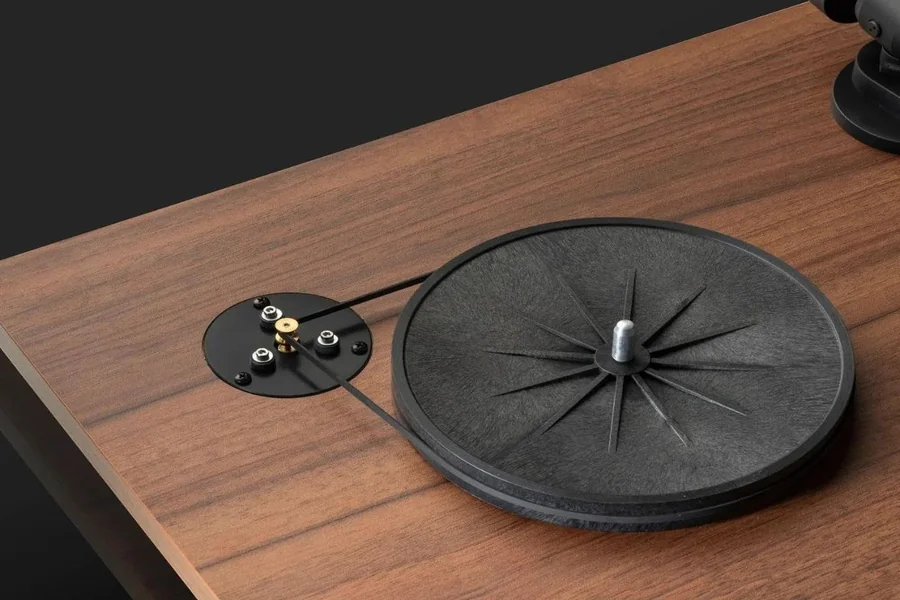
A direct drive turntable mounts the motor directly under the platter while a belt drive turntable has a rubber or silicone belt that connects the motor to the platter. Belt drive models are frequently selected for home listening systems because the belt helps to reduce the transfer of vibration from the motor to the platter. With faster start-up times, rock solid speed stability and control, it is no surprise that DJs and users who require accurate platter response, prefer direct drive turntables. Both designs are not necessarily better. It will depend on your listening goals, priorities, budget and if you’re going to be DJing or just enjoying records at home.
It can be confusing to buy a turntable, particularly when you begin to consider belt drive vs direct drive turntables. Decades-old designs and both can deliver great sound. The primary difference lies in the way the platter is rotated by the motor.
This difference has an impact on more than just the turntable’s construction. It can impact on vibes, speed control, maintenance, start-up time and usage of the turntable.
What Is A Belt Drive Turntable?
A small motor is separate from the main platter in a belt drive turntable. A flexible belt is used to join the motor pulley to the platter. When the motor is spinning, it’s then transferring that spin to the platter through the belt.
This design was popular as the belt can help to minimize vibration transfer from the motor. Not being directly coupled to the platter means that vibrations from the motor are less likely to be transferred to the record and stylus.
This can be helpful for those listening at home. Unlike vinyl playback, which is limited by the need to track minuscule grooves on the record, vinyl requires no physical contact and therefore includes no stylus. A good belt drive design can then result in a quiet, stable listening experience.
Advantages of belt drive turntables
- The platter is physically separated from the motor’s vibration.
- Many models feature mechanical systems that are easy to operate and quiet.
- They can be found in a variety of price ranges.
- Replacing a belt is typically inexpensive.
- They make great home entertainment and sound system speakers.
- Belt drive designs are featured in many turntables geared towards audiophiles.
Disadvantages of belt drive turntables
- The belt might be worn or stretched over the years.
- Startup will typically be slower than direct drive.
- Some models may require longer to stabilize the speed change.
- Other inexpensive turntables with belt drive are not as accurate at speed control.
- They are generally not as appropriate for use with DJ techniques that involve moving around the platter.
Don’t assume that a belt drive turntable is better just because it uses a belt drive. The quality of the motor, platter, bearing, tonearm, cartridge, power supply and overall construction is also important.
What Is A Direct Drive Turntable?
A direct drive turntable has the motor mounted directly under the record platter. The motor powers the platter, rather than a belt.
In this design, the platter is directly connected to the motor. This means that direct drive turntables can start spinning very rapidly, and can achieve good speed control.
This makes them particularly handy for DJs. A DJ will have to stop and start records, alter platter speed, cue tracks, or slow down and speed up the record. Direct drive systems are engineered to perform these actions better.
Outside of DJing, direct drive comes in handy too. A direct drive turntable may be desirable for some home listen with its fast response and accurate speed control.
Advantages of direct drive turntables
- The benefits of direct drive turntables are numerous.Direct drive turntables offer many benefits.
- Quick start-up and shut-off.
- Good speed stability of well-designed models.
- No replacement drive belt.
- Excellent platter control.
- Ideal for DJs and turntablists.
- Frequently gives accurate electronic speed control.
- Is able to use and handle frequently with good results.
Disadvantages of direct drive turntables
- Motor vibration can potentially reach the platter if the design does not isolate it effectively.
- High-quality direct drive systems can be expensive.
- Some budget models may prioritize features over overall build quality.
- The direct motor connection does not automatically mean better sound.
The last point is important. Direct drive technology has sometimes been associated with DJs, while belt drive has been associated with audiophile listening. These categories are useful as general guidelines, but they are not absolute rules.
Belt Drive vs Direct Drive: Key Differences
The easiest way to understand the difference is to compare the features that matter during everyday use.
Sound quality
When it comes to comparing the two technologies, one of the biggest concerns often is sound quality. But that’s not all that makes a turntable sound.
A properly created belt driven turntable can sound great. A good Direct Drive turntable can also be a great choice. In reality, the cartridge, stylus, tonearm, platter, bearing, phono preamp, isolation and motor control all have a huge influence.
The quality of your records is also important. Clean, well-maintained record played with a properly aligned cartridge, can make more difference than just switching from belt drive to direct drive.
Speed stability
The advantage of direct drive systems is that they can achieve fast and accurate speed control when this is a key factor. The motor directly drives the platter and some models include electronic systems to monitor and regulate speed.
Very good speed stability is also possible with belt drive turntables. Better models employ well-designed motors, belts, bearings and power supplies to ensure steady spinning.
If you’re using a turntable for regular home listening purposes, you can get by with a reasonably fast belt drive turntable, and it will deliver the right level of speed stability. The difference is more apparent when you look at individual models and not the two technologies in general.
Vibration and noise
Belt drive turntables are naturally better for motor isolation as the motor is not attached to the platter. The belt provides a cushion between the motor and platter.
A direct drive turntable must work to control motor vibration by engineering and isolating. This can be achieved effectively with modern designs, but it is implementation that counts.
That’s why it’s advisable to make comparisons between individual turntables rather than assuming that one drive system is always quieter than the other.
Which Turntable Is Better For Home Listening?
Belt drive can be a good option for those who primarily use the record player to play music at home. It is very well designed to be used in listening sessions where a record is placed on the platter, playing is started and the turntable is let run.
There are also belt drive models available in a variety of prices. This is the system that is used for many entry level and mid-range home turntables.
However, in the home listening environment, there is no reason to not use direct drive. It’s possible to get very good performance and speed control from a quality direct drive turntable. Direct drive could be appealing to those who appreciate speedy start-up time or want a more reactive platter.
There are many factors to consider when selecting a turntable for your home use:
- The quality of the cartridge and options for upgrading.Cartridge quality and upgrade options.
- Tonearm construction
- Bearing quality; platter quality.
- Speed accuracy
- Vibration isolation
- Phono output or built-in phono preamp.
- Build quality
- The availability of spare parts.
- Your overall budget
These will be more important than just belt versus direct drive.
Which Is Better For DJs And Turntablists?
Direct drive is the more suitable design for DJs, due to its quick response and platter control.
DJs have to do things not done at home. They can pause the platter with their hand, control the platter’s speed to play faster or slower, use the scratching techniques, or even switch between songs in a flash.
This can be responded to rapidly by a direct drive motor. No waiting for a belt to pull tight after it has accelerated to the desired speed before the platter can accelerate again.
Typically, the belt drive turntable isn’t made for this type of application. Repeated manipulation of the platter can add strain on the belt and could make manipulation more difficult.
Some belt drive equipment can be used for casual mixing, but many DJs require precise control and will typically opt for direct drive.
Belt Drive vs Direct Drive: Which Should You Buy?
It is a matter of personal taste and depends on what you are looking for in your turntable.
Choose a belt drive turntable if:
- You primarily listen to records at home.
- You wish to have a simple playback oriented setup.
- Motor isolation will be a critical factor.
- No need to make any adjustments to the platter.
- You can easily replace a belt if needed.
- You’re in the market for a turntable that’s made with the core function of playing records.
Choose a direct drive turntable if:
- As a DJ or turntablist.As a turntablist or DJ.
- Quick start-up and shutdown.
- It is vital to have accurate control of the platter.
- You frequently change or adjust playback speed.
- You don’t want to have to change out belts.
- You value good speed control and quick response.
- Then there’s a third factor—namely, the particular turntable.
Then there’s a third factor—namely, the particular turntable.
Even a good, direct drive model can outperform a poorly designed belt drive model, and vice versa. Don’t just go for the drive system, consider the overall design.
For novices, the important thing is to invest money in getting a good turntable that’s fairly well constructed and equipped with a good turntable cartridge, a steady speed, a good tonearm, and proper isolation, rather than the drive type of the motor: belt or direct.
Final Thoughts
There is no single right answer to the belt drive vs. direct drive turntable argument. Both technologies are good, and both can provide fun vinyl playback, if designed correctly.
Belt drive turntables are suitable for the home listener, who is looking for the simplicity of record playing. They’re popular for traditional vinyl setups due to their motor isolation and availability.
For cases where speed control and platter response are important, a direct drive turntable comes into its own. This feature is especially helpful for DJs, turntablists and listeners who value exact electronic speed changes.

1 Comments