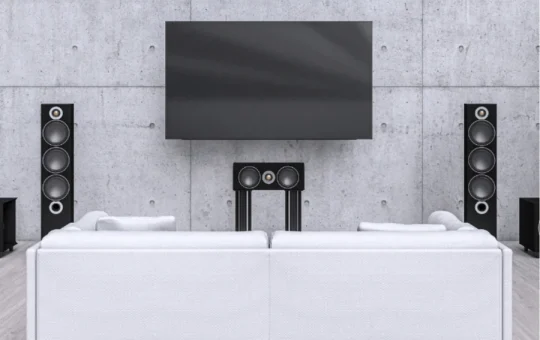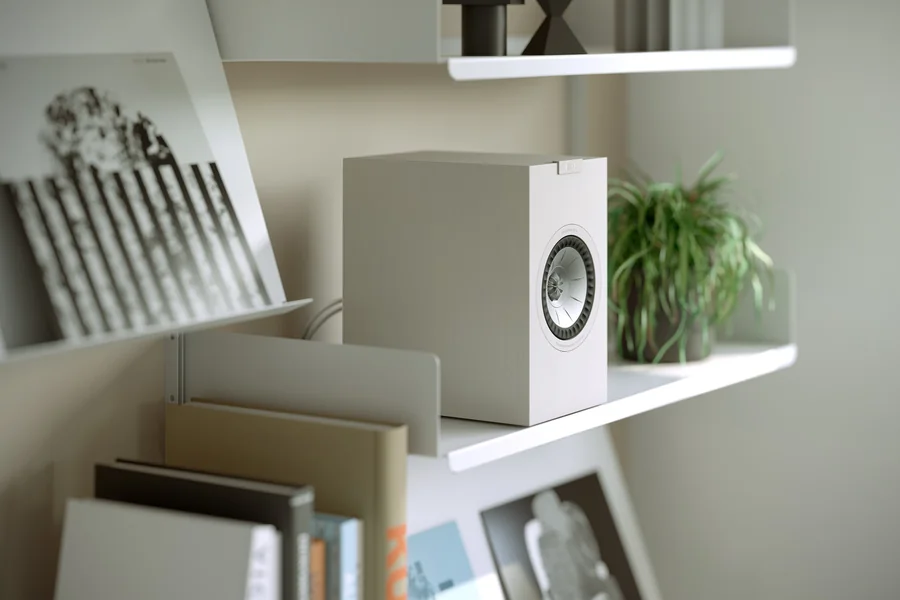
When selecting speakers for your room size you need to match up the speaker’s physical size, power, sensitivity and bass output with your room size. Compact bookshelf speakers are a great choice for small rooms as they don’t overpower the space with sound. Medium rooms will get more versatility from medium sized rooms, and larger rooms will see the advantage of floor-standing speakers or bigger bookshelf speakers with subwoofer. The idea isn’t to purchase the largest speakers possible. An effective speaker should evenly fill the room, achieve balanced sound and operate the amplifier and listening distance at a comfortable level.
Why Room Size Matters When Choosing Speakers
People typically consider brand, price, power or look when shopping for speakers. The size of the room can also be significant. What sounds balanced in one room won’t necessarily sound balanced in another.
The way sound can travel from room to room is influenced by your room. Reflections and bass response will be affected by walls, ceilings, furniture, windows and floors. Rooms with small dimensions are particularly affected by low frequencies. A speaker with deep bass response may cause the bass tones to be boomy in a compact space. A small speaker in a large room might not have sufficient volume and scale to make a difference.
This is not to say that the rule is: If the room is small, the speaker has to be small, and if the room is large, the speaker has to be large. It’s more advisable to look at multiple factors all at once.
Important considerations include:
- Room size: Length, width, and the vertical dimension of the ceiling are all important.
- Listening distance: Speakers must perform well at your normal listening distance.
- Speaker sensitivity: The sensitivity of the speakers determines how much amplifier power is required for a given sound level.
- Amplifier power: The amplifier should be appropriate for the speakers and your listening preference.
- Bass output: The bigger the speaker, the more air it will move, but more bass isn’t always desirable.
- Placement: Distance of walls and corners can have an impact on sound.
Different listening volumes: A listener who listens quietly has other needs than a listener who frequently hears music at a loud volume.
Speaker Size Guide by Room Dimensions
No single rule exists for choosing speakers, although room size is a first approximation.
| Approximate Room Size | Recommended Speaker Type | General Guidance |
| Up to 100 sq. ft. | Compact bookshelf speakers | Keep bass controlled and avoid overpowering the room |
| 100–200 sq. ft. | Bookshelf or compact floorstanding speakers | A flexible range for most home listening |
| 200–300 sq. ft. | Larger bookshelf or floorstanding speakers | More output and bass may be useful |
| 300+ sq. ft. | Floorstanding speakers or large bookshelf speakers + subwoofer | Consider greater output and wider room coverage |
These measurements are just recommendations and not hard limits. A room with a large amount of furniture, heavy pieces and soft surfaces can sound completely different than a room that has very little furniture in it.
Bookcase speakers typically make a simple and convenient first choice for small bedrooms, offices or tight living rooms. These occupy less space and can achieve detailed sound without creating too much low frequency energy.
There are more choices for a medium sized living room. Stand mount speakers are okay with good bookshelf speakers. If you desire greater bass and size of presentation then compact floorstanding speakers are an alternative.
If you have a large space, floor standing speakers provide more output and bass response. A good bookshelf speaker and a well-integrated subwoofer, though, also can be a good solution.
How To Choose Bookshelf Or Floorstanding Speakers
Book (shelter) speakers and floor standing speakers have a strong relationship with the size of your room.
The bookshelf speakers are small and typically simpler to set up. They make good consideration under limited space conditions. They are also smaller in size and require less space for installation than larger cabinets.
They are particularly effective when:
- You have a small to medium sized room.
- Speakers are relatively close by.
- You wish to install a subwoofer.
- Your home has a small amount of floor area.
- You like a basic stereo system.
Bookshelf speakers don’t require low-level sound. If designed properly, a pair can yield superb clarity and images. Low bass extension and maximum output are often the biggest drawback of smaller floorstanding designs.
Floorstanding speakers are larger and will usually feature multiple drivers. These are able to move more air, and often will deliver a deeper bass without requiring a separate subwoofer.
They are more appropriate when:
- You have a medium or large room.
- The listening position is at a distance of several feet.
- You are looking for good range response.
- You regularly listen at higher volumes.
- There is sufficient room for correct placement.
However, larger does not necessarily equal better. If a large floorstanding speaker is too close to a wall in a small room, it may produce too much bass and cause a difficult to balance system.
Match Speaker Power, Sensitivity, And Listening Distance
But room size is not the only thing to consider. Another thing you’ll want to grasp is the efficiency of the speaker’s converting amplifier power to sound.
Speaker sensitivity is usually measured in decibels (dB). The more sensitive a speaker, the more sound it will create with a given amount of amplifier power.
This is important because with increased room size and distance to listen, greater acoustic output may be needed.
For instance, two speakers with similar sound qualities. One is more sensitive rated. May require less amplifier to achieve desired listening level.
Still don’t choose the speakers just because they are sensitive. All of this is important, including impedance, amplifier power and speaker design, and the sound level you prefer.
Listening distance especially. Some chairs are sitting 6 feet away from the speakers, and may not require the same output level as another chair 12 or 15 feet away.
As a basic principle:
The greater the listening distance, the larger the room, and the volume, the more speaker output is required.
Your amplifier should also be powerful enough to drive your speaker(s) correctly. A poorly matched amplifier will not perform as well as it can when used with demanding speakers and can cause clipping with high demanding levels.
Consider Bass, Placement, And Room Acoustics
One of the largest factors in speaker selection is bass.
There are naturally certain low frequencies that rooms reinforce. The effects are known as room modes. They may increase the volume of some bass notes and decrease the volume of others.
That’s why some speakers sound perfectly balanced in the showroom, but sound quite different at home.
This can be helped by speaker placement.
Do not set speakers on a wall unless the manufacturer recommends it. Many speakers will produce more bass when they are closer to a wall. This effect can be further enhanced with corner placement.
If you are using a stereo setup, make sure to make the setup as symmetrical as possible. It is important that, if possible, the distance from the side walls to the left speaker be the same as to the right speaker.
A good starting point is:
- Put the speakers a few feet from each other.
- Point tweeters in the approximate direction of the ear.
- Maintain a fairly balanced left and right side.
- Set back to front wall, leaving some space between the speakers.
- Don’t position one speaker in a corner and the other in an open area.
- Always use speaker stands for bookshelf speakers, when applicable.
The room furnishings are also important. Hard surfaces and bare walls can generate strong reflections. Some of that energy can be absorbed or scattered by curtains, rugs, sofas and other furniture.
You don’t have to make your living room into a studio! Often small adjustments in placement make a huge difference.
Choosing Speakers For Different Listening Styles
Your room should be taken into consideration with the way you actually listen.
For those who enjoy listening to vocals, acoustic music, and jazz, podcasting or classical music, that might mean midrange accuracy and good imaging might be more significant than maximum bass.
Deeper bass and more output might be more significant if you prefer rock, electronic, hip-hop or movies. If you have bookshelf speakers, you can find a subwoofer useful here.
You don’t necessarily need big speakers if you are listening mostly at low or moderate volume, as your room could be large. Great pair of bookshelf speakers can still be fun.
High output capability is more important if you’re playing at high volume on a regular basis. In such cases, higher powered and more sensitive speakers may be better.
The calculation is slightly different for the home theater. You must take into account the whole speaker system, such as the center speaker, surround speakers, subwoofer, and receiver/amplifier.
The speaker choice can also be changed by a subwoofer. If you don’t want to spend money on the lowest frequencies, you can purchase good bookshelf speakers and leave the lower frequencies for the subwoofer.
This can be helpful in situations where floor area is limited.
Common Speaker Selection Mistakes To Avoid
When you know what to avoid, it’s easier to purchase speakers.
Choosing based only on size:
You can’t tell by the size of a large cabinet that the sound is better. Design of the driver, quality of the crossovers, construction of the cabinets, sensitivity and placement are all important.
Ignoring your amplifier:
It’s easy to have a wonderful speaker specification but not be a good fit for an amplifier which can’t drive it at the same reasonable level.
Buying for the room you wish you had:
Select speakers for your actual room. You don’t have to have a massive pair of floorstanding speakers in a compact apartment.
Putting speakers wherever they fit:
Stereo imaging and bass are very affected by placement. Allow the speakers to have space to work.
Ignoring the listening position:
The distance from which you will be seated will determine your output requirements. Consider location, not where you may sometimes hear.
Assuming more bass is always better:
Excessive bass can cause a muddy sound in music. There’s more to balanced bass than too much bass.
Forgetting about a subwoofer:
A subwoofer could be used to enhance the low frequency response without having to use huge mains. It also provides greater flexibility when building a system.
Before making your purchase, take the dimensions of your room and determine the location of your speakers and listening position. Then look at the speaker’s size, sensitivity, impedance, suggested amplifier range and frequency response.
If possible, listen to the speakers in your own room. Home demonstrations or return policies can be useful due to the different room conditions.
Final Thoughts
There is not any hard-and-fast answer to choosing a speaker suitable for your room size, it’s about making a balance. Begin by working out your room size and then take into account listening distance, desired volume, speaker sensitivity, bass needs, amplifier compatibility, and placement.
Compact bookshelf speakers may be a good choice for smaller rooms. Medium rooms provide more flexibility. For larger spaces, floorstanding speakers or a combination of a bookshelf speaker and a subwoofer might be more suitable.
The key first is to match the speaker to space and listening habits. If the speaker is placed in the right spot and matches the room, it will sound much better than if it was placed in an improper location and has a poor match. Measure, think about amplifiers and how you really listen before buying.