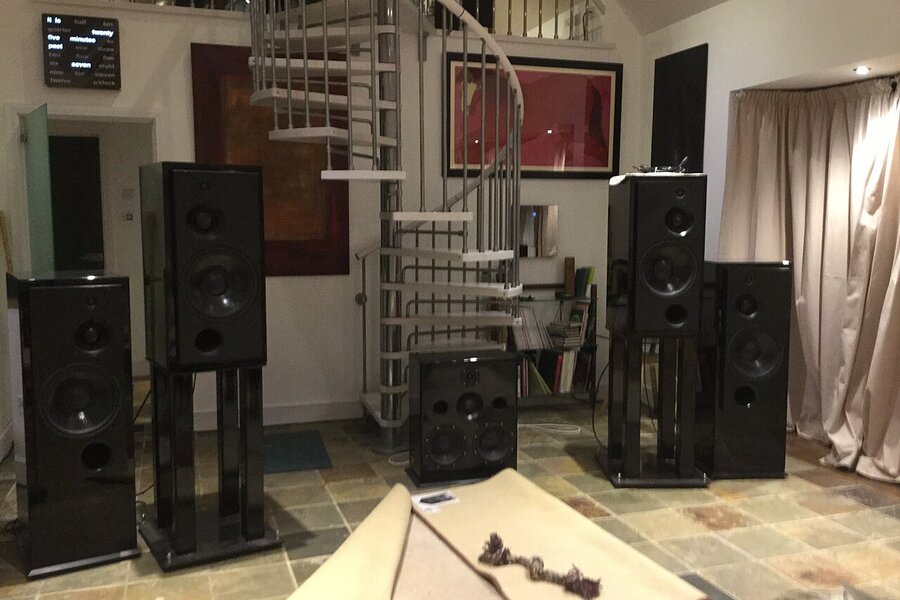
Expensive speakers are part of the equation, but so are other factors that contribute to good sound. Their placement in a room can have a dramatic impact on stereo imaging, bass response, vocal clarity, and comfort of listening.
Proper placement of 2 channel speaker placement aids in the combined effort between the speakers. They can be used to produce a realistic stereo effect when set up correctly, making music sound wider and more natural.
But each room has unique characteristics. The effect depends on furniture, wall materials, speaker design, listening distance, etc. The idea isn’t about following the one measurement, but about having a solid base point to start and making careful adjustments.
For related advice, read how to choose speakers for your room size, compare bookshelf and floorstanding speakers, or see how to build a hi-fi sound system on a budget.
This guide provides tips on where to place bookshelf speakers and floor standing speakers, what to do and what not to do and how you can use simple tricks to enhance sound without the added expense of extra equipment.
Featured Answer
Two channel speaker placement is the art of setting up two speakers for balanced stereo sound, clear vocals, accurate instrument placement and natural bass response. To begin with, come up with the speakers at the same distance from your listening point, making an approximate equilateral triangle shape, and avoid walls as much as possible. Fine-tune speaker placement, toe-in, and spacing for your room, equipment, and listening style.
Why 2 Channel Speaker Placement Matters
Two channel stereo system is a stereo system with two audio channels, typically the left and right audio channels. Each speaker echoes his/her own assigned signal to produce a sense of width and direction.
For tested speaker recommendations, see WIRED’s best speakers guide.
The speakers are aligned properly, and vocals might seem to be in the middle between the speakers, and instruments could be in various positions inside the stereo image.
Poor positioning can cause the sound to be uneven. The one speaker might sound louder, the bass might be too loud, or the vocals might sound like they are coming from one side.
There are several enhancements to listening that can be enhanced with good 2 channel speaker placement:
- Stereo imaging: Aids in positioning voices and instruments.
- Increases width of sound stage: Makes recordings sound more spacious.
- Clearly voiced: Aids speech or singing to be clear.
- Bass balance: Alleviates some of the bass issues associated with placement.
- Listening comfort: Generates the same sound level at the primary-listening position.
Positioning of the speaker will not solve all problems. In some cases it may be necessary to solve the problem of distortion on recordings, weak amplifiers, inappropriate speakers, and poor room acoustics separately.
How to Position Two Speakers Correctly
1. Start With an Equilateral Triangle
It’s helpful to set up the two speakers and your primary listening spot in an approximately equilateral triangle.
The distance between the speakers will be approximately equal to the distance between each speaker and your ears.
If the speakers are 2 meters apart, start out by sitting approximately 2 meters away from both speakers. These measurements are guidelines, not rules.
A balanced stereo image is frequently an equilateral triangle. A narrow soundstage can be experienced if the speakers are positioned too close together. Too far apart and the center image can be weak or vocals might sound disconnected.
Try out making small changes on familiar recordings.
2. Keep Both Speakers Equidistant From Your Listening Position
Symmetry is one of the key aspects of 2 channel speaker placement.
When listening to the speaker’s words, keep a distance between each speaker and your ears as equal as possible. When one speaker is very close, the voice can be heard first and be louder.
To determine both distances, use a tape measure. A slight modification can make a difference to the center image.
Other walls and furniture nearby should also be taken into account. Reflections and perceived tonality are also impacted by a large cabinet next to one speaker, but not the other.
3. Speaker Height is correctly set.
For many traditional stereo speakers, the ear level at the main listening position is a good starting point with many of these speakers.
The tweeter is responsible for a lot of the high frequency detail that creates clarity and imaging. Sitting too far ahead or behind the speaker’s listening line may slightly alter the tonality.
Bookshelf speakers can be mounted on any appropriate stand. If they are floor-mounted, they should be set up as per manufacturer’s instructions.
Do not place speakers on unsteady furniture. Vibrations can create unwanted noise and if the speaker is not secured, it may fall.
4. Adjust the Distance Between Speakers
The stereo width is heavily dependent on speaker spacing.
Begin with a medium distance between speakers, then increase or decrease the distance between them by a small distance. Listen to well-balanced vocals, acoustic sounds and music that are well separated.
Speakers should be distant enough apart that the stereo presentation is not compressed. Too much space may create a middle space or lessen the impact of the central image.
The distance will vary based on speaker directionality, distance to the listener and room acoustics. There is no universal spacing that is suitable for all systems.
5. Experiment With Toe-In
Toe-in is the term used to describe turning the speakers slightly inward towards the listening position.
This change may affect high-frequency balance, stereo focus and the amount of sound bouncing off side walls.
Try three positions:
- Your speakers pointed right at your ear(s).
- Speakers faced slightly inwards.
- Speakers with greater toe-in.
Pay attention to clarity of voices, solid imaging and relaxed treble. Some speakers are best when directed straight at the listener, others are best with a smaller angle.
Never make big changes without consulting the speaker’s manufacturer.
Understanding Speaker Distance From Walls
Walls influence the sound produced by loudspeakers. They reflect sound waves, and can amplify or dampen specific frequencies at the listener’s location.
Rear-Wall Distance
The speakers can be positioned near the wall behind them to enhance the bass perception, depending on the speaker and the room.
Additional clearance is sometimes provided by some rear-ported speakers, but rear ports do not necessarily mean a speaker can’t be placed close to a wall. Follow manufacturer’s instructions.
Adjust speakers from forward to back and vice versa in small increments and check the bass response.
Side-Wall Distance
Side-wall reflections may affect stereo imaging and tonality.
If possible in the room, make distances to the left and right side walls similar. Perfect symmetry may not be possible if one speaker is located near an open doorway and the other speaker is near a solid wall.
If that’s the case, make sure to be at the same distance from the speakers and then rearrange the set-up according to the sound they are making.
Listening Position
Your chair also has an impact on bass response. Positioned right up against a wall or on the edge of a room may cause a significant variation in frequencies.
Adjust the height of your listening chair a little bit forward or back. Sometimes a slight adjustment in the position of your seats is more effective in enhancing bass than rearranging the speakers.
Recommended Starting Positions
|
Setup factor |
Suggested starting point |
What to check |
|
Speaker spacing |
Similar to listening distance |
Natural stereo width |
|
Listening distance |
Equal from both speakers |
Stable center image |
|
Tweeter height |
Near ear level |
Clear vocals and detail |
|
Toe-in |
Slight inward angle or manufacturer setting |
Focus and treble balance |
|
Rear-wall clearance |
Follow speaker guidance |
Bass balance |
|
Side-wall spacing |
Keep reasonably symmetrical |
Imaging and reflections |
|
Speaker support |
Stable stands or suitable floor placement |
Reduced unwanted movement |
These are starting guidelines, not mandatory measurements. The best 2 channel speaker placement depends on the actual room and loudspeakers.
Best Placement for Different Room Types
Small Rooms
When speakers are being moved in SMALL rooms, limits may be imposed on their distance from walls. For compact bookshelf speakers, while they might be practical, the bass response will still rely on design and placement.
Start out with moderate spacing and do not position the speakers directly in corners unless the manufacturer says it is advisable.
If bass is sounding too loud, consider placing the speakers further away from the closest wall. Try the listening position first if there is limited space.
Large Rooms
Larger rooms can provide more room for separation of speakers and listeners.
But, do not automatically place the speakers as far away from one another as possible. Maintain a consistent center image and ensure the speakers remain an integral part of the stereo image.
Take the listening space into account, not the room size. Speakers should be set up around the seat you listen to the most.
Living Rooms
Television sets, sofas, tables, curtains and other items can impact the sound reflection in living rooms.
If possible, position speakers at a similar distance from the television/central furniture. Don’t place them behind big things.
When speakers are required to stand near a television, avoid blocking the drivers with the television and furniture.
Desk and Nearfield Listening
The listening distance for desktop systems is typically close by. Position the speakers at ear level and point them towards the listener.
Ensure that your left speaker and right speaker are about the same distance away from your head. If possible, don’t make one speaker stand close to a wall and the other speaker stand in full view.
While nearfield listening can minimize some room reflections, they can’t be removed.
Common 2 Channel Speaker Placement Mistakes
The two speakers are positioned too close together.
Tight spacing can decrease the width. Then start to increase the distance slowly and see if the centered vocals are still in tune.
Speakers too far apart will cause distortion.
Too wide of a spacing can reduce the depth of the stereo image. Move speakers closer to be able to hear voices and instruments together.
Not using the Listening Seat
The placement of speakers and seating position complement each other. Moving speakers alone will not solve all sound issues.
Using Unequal Distances
Timing and imaging can be impacted by unequal distances. Use measuring tools instead of visual estimation.
You must place Speakers in Corners Without Testing.
Corners can accentuate bass and boost some recordings to be boomy. Evaluate other seating options if possible in the room.
When making new changes, do not make too many at once.
Variations in individual variables. When making all three adjustments (spacing, toe-in, and wall clearance) at once, it’s hard to determine which change makes the sound better.
How to Test and Fine-Tune Your Setup
Instead of only using unfamiliar demonstration songs, use familiar music.
Select one recording that has a distinct cut centre vocal, one that has a good-wide stereo mix and one that has consistent bass.
Follow this process:
- Annotate the original speaker’s locations.
- Ensure distance from listening position is the same.
- Make gradual changes to speaker distance.
- Try with various toe-in angles.
- Compare rear-wall clearance.
- Move the chair, if the base is still uneven.
- Go to the best position, and listen at a comfortable level.
If a more technical approach is wanted, room-measurement software and appropriate measurement microphone may be helpful to determine frequency-response issues. While the measurements are helpful, keep in mind that your listening preferences and listening conditions are important.
Final Thoughts
The basic guidelines for good 2 channel speaker placement are to ensure equal listening distances, reasonable speaker spacing, speaker height, and attention to the room. There’s no need to buy a lot of expensive accessories to get started enhancing your system.
With a symmetrical setup, try toe-in, wall clearance and seating position. Just one adjustment and assess using familiar recordings.
The best system is the one which produces clear vocals, balanced bass, good stereo imaging, and comfortable listening in the actual room. Use standard measurements as an approximation, be wary of comparisons and adhere to the instructions of the speaker manufacturer for the best practical effect.
FAQs
1. How far apart should two stereo speakers be?
Start with speaker spacing approximately equal to the distance from each speaker to your ears. Adjust the spacing until the stereo image sounds wide but remains connected in the center.
2. Should stereo speakers face directly toward me?
Not always. Some speakers benefit from direct aiming, while others sound better with less toe-in. Compare several angles and follow the manufacturer’s recommendations.
3. Should speakers be close to the wall?
It depends on the speaker design and room. Wall proximity can change bass response, so begin with the manufacturer’s recommended clearance and adjust by listening.
4. Is speaker height important for stereo sound?
Yes. Tweeter height can affect high-frequency response and imaging. For many conventional speakers, ear-level tweeters provide a useful starting point.
5. Can correct placement improve bass?
Yes. Moving speakers or the listening seat can reduce some bass peaks and cancellations. However, room modes may require additional acoustic treatment or bass management.
6. Does 2 channel speaker placement matter with a subwoofer?
Yes. The main speakers still need balanced stereo imaging, and the subwoofer needs suitable integration. Correct crossover settings, phase adjustment, and placement can improve the combined response.