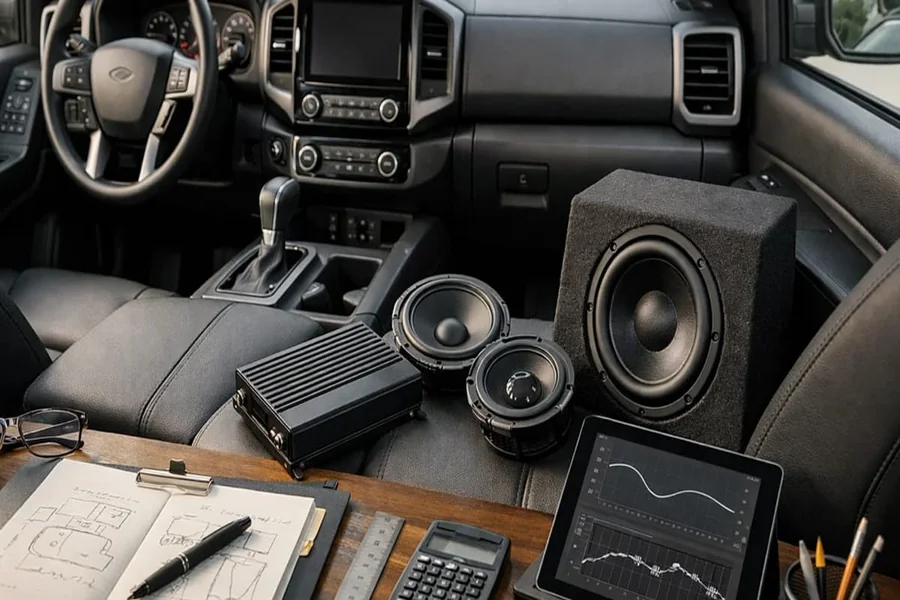
Upgrading a car audio system means swapping out or adding components—speakers, amplifiers, subwoofers, or a new head unit—to get better sound than what came from the factory. Most stock systems are designed around price, rather than quality, which means even minor changes can have a big impact. It is not necessary to change all the components at the same time. An effective well-placed upgrade with proper execution can often outperform a hasty overhaul. This guide explains what, when and why you need to change.
Why Factory Systems Never Really Impress
Here’s the thing about factory audio: car manufacturers aren’t in the business of building great speakers. They’re in the business of building cars, and audio is one of dozens of line items competing for the same budget. So corners get cut—thinner speaker cones, weaker amplifiers, cheaper wiring.
You’ve probably noticed some of this already:
- Bass that sounds thin or muddy instead of tight
- Vocals that disappear once the mix gets busy
- Volume that distorts before it gets loud
- Rattling panels or buzzing doors
- A head unit that feels like it’s from a decade ago (because, often, it is)
None of that means your car has a problem. It just means audio wasn’t the priority when it was built. Once you understand that, it’s easier to see where your upgrade dollars will actually count.
Figure Out Your Budget and What You Actually Want
Before you buy anything, sit with two questions: how much are you willing to spend, and what do you actually want out of this? Car audio upgrades run the gamut—$150 gets you new speakers, $3,000 gets you a full system rebuild with a dedicated amp rack. Both are valid, but only if they match what you’re chasing.
Think about your listening habits. Do you mostly want cleaner sound at normal volumes? Louder, punchier bass? Clearer phone calls in a noisy cabin? Each answer points toward a different starting point.
A trick that works well: spend first where the weakness is most obvious. If your speakers sound tinny, start there—don’t buy a subwoofer to compensate for bad mids and highs. If your speakers are fine but your bass has zero presence, a sub is probably your next move. Trying to fix everything simultaneously, without a plan, is how people end up with mismatched gear that fights itself instead of working together.
Start With Speakers—Almost Always
If you’re upgrading one thing, make it speakers. They’re the final link between your music and your ears, and in most cars, they’re also the weakest one.
You’ll generally choose between two types:
- Coaxial speakers. Everything—tweeter, woofer, sometimes a small crossover—is built into a single unit. They’re cheaper, easier to install, and a smart pick if this is your first upgrade.
- Component speakers. The tweeter, woofer, and crossover are separate pieces, mounted independently. Installation takes longer and costs more, but the sound separation is noticeably better.
Don’t skip the specs. Check power handling and sensitivity before you buy—a speaker rated well above what your head unit or amp can push simply won’t perform the way it’s supposed to. And check the physical size fits your door panels; not every speaker fits every car, and that’s an easy mistake to make when you’re excited to order something.
Think About a Subwoofer
If bass is what you’re after, a subwoofer will probably satisfy you faster than any other single upgrade. Even good factory speakers struggle with low frequencies—it’s just not what they’re built for. A sub fills that gap almost immediately.
A few common setups:
- Powered subwoofers come with a built-in amp, so there’s less wiring involved. Good if you want simpler installation.
- Component subwoofers need a separate amplifier, but give you more control over tuning.
- Loaded subwoofer boxes are pre-built enclosures, ready to wire and drop in.
Box type changes the sound. Sealed enclosures give you tight, accurate bass. Ported enclosures give you louder, boomier bass. Neither is “better”—it depends on whether you want precision or volume.
One practical note: subs take up space, usually in the trunk. If you regularly haul groceries, luggage, or gear, factor that into your enclosure size before you commit.
Get an Amplifier Involved
Here’s something a lot of people don’t realize until they’ve already bought new speakers: factory head units don’t put out much power. Often, it’s not enough to actually drive upgraded speakers or a subwoofer properly. That’s what an amplifier fixes—it delivers clean, adequate power instead of asking your head unit to do a job it was never built for.
Amps come in a few configurations:
- Mono amps are built for a single subwoofer, nothing else.
- 2-channel amps can run a pair of speakers or a sub, depending on how you wire them.
- 4- or 5-channel amps can handle a full speaker set and a subwoofer at once, which is why they’re the go-to for people doing a complete upgrade.
Match the amp’s output to what your speakers and sub can actually handle. Too little power and everything sounds weak. Too much, and you risk blowing something out. Manufacturers publish recommended ranges for a reason—use them.
Installing an amp also means running new wiring: power cable, ground wire, remote turn-on lead, the works. This is genuinely one of the trickier parts of the whole process, and it’s where a lot of people decide professional installation is worth the money.
Replace the Head Unit
The head unit runs the show, and if yours is more than a few years old, it’s probably missing features you didn’t even realize you wanted. Swapping it out improves sound, sure, but it also just makes the car nicer to drive.
Modern units typically bring:
- Bluetooth for calls and streaming
- Touchscreens that don’t feel like they’re from 2009
- Apple CarPlay or Android Auto support
- Built-in equalizers so you can tune sound yourself
- Cleaner internal amplification than what shipped stock
Before buying, check your dash opening—single-DIN or double-DIN—and confirm your wiring harness compatibility. Some cars need an adapter kit, and it’s worth a five-minute search for your specific make and model before you order anything. Nothing kills momentum like a head unit that shows up and doesn’t fit.
The Upgrade Nobody Talks About: Sound Deadening
This one gets skipped constantly, and it shouldn’t. Car doors and panels vibrate when speakers play, and that vibration creates rattling and muddies your sound. A sound deadening mat applied to doors, the trunk, and other panels cuts that vibration down significantly.
It’s not exciting. Nobody brags about their sound deadening mat. But speakers mounted in a deadened door sound noticeably tighter, because less of their energy gets wasted shaking the panel instead of producing clean sound. It also quiets road noise, which matters more than people expect once they’ve actually experienced the difference at highway speed.
It’s cheap, and if you’re already pulling door panels off to install new speakers, this is the moment to add it. Skipping it now just means redoing the work later.
Installing Everything: DIY or Pro?
After you’ve selected your equipment, you have two choices: you can do it yourself, or you can call in the professional.
Simple things like speaker swaps, powered subwoofer, etc. come in handy with DIY. The basic tools, a wiring diagram for your car and a bit of patience are required. Most popular models have numerous tutorials available on the web.
Larger tasks like adding an amp to your car or mounting a new head unit to your dash and connecting the factory controls to it usually run more smoothly with a professional. The good installer also ensures that your wiring is safe, that your fuses are properly sized and that your battery won’t fail you at 2 a.m. when a fuse fails because of a wiring mistake.
Before starting work, disconnect the battery, whichever way you are going. Also, photograph the wiring at the factory before any work is done; when reassembling, you’ll be thankful for saving that picture.
Test It, Then Tune It
After installation, don’t assume that everything is set up correctly. Mix a few genres, a bass-heavy one, a vocal-heavy, a high dynamic range and really pay attention to how the system handles each of them.
Aftermarket head units will typically have equalizer controls. Use them. If you’ve included a subwoofer, take the time to set up the gain and low-pass filter on the amp so it doesn’t overpower the rest of the system.
Listen for rattling, distortion or one side being louder than the other. These are almost invariably caused by installation rather than fault and are likely due to a loose panel or a wiring fault. If you catch it now you will avoid causing damage later.
Final Thought
It’s not necessary to replace your entire car audio system in one weekend. Begin with the thing that is bothering you the most, be it weak speakers, flat bass, and out of date head unit. Have a realistic budget, check for compatibility before purchasing, and don’t hesitate to turn over the tougher wiring to the professionals. Build it up piece by piece, and you will have a system that isn’t shoved down your throat, but that you can actually choose.


3 Comments