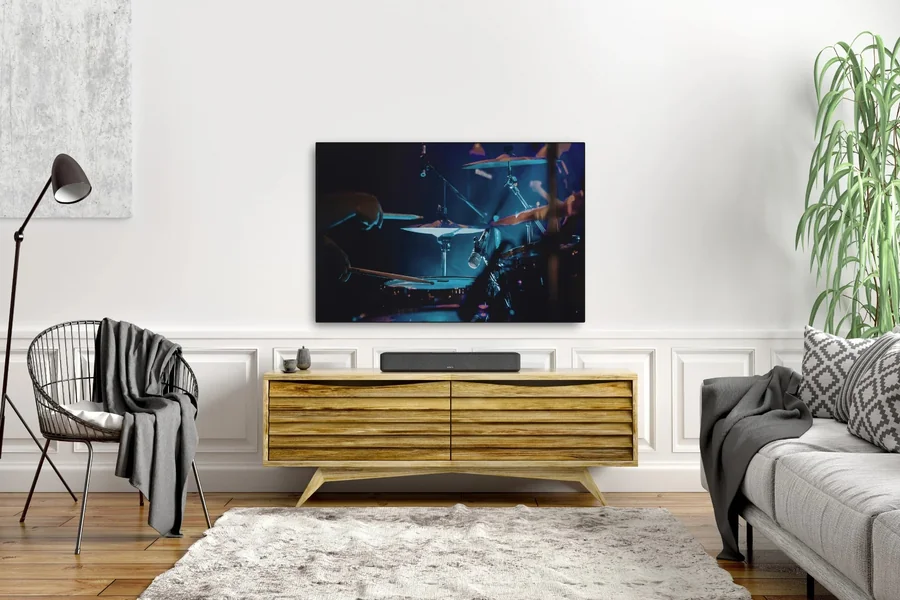
A soundbar is a compact speaker system that sits under or near your TV, and bookshelf speakers are left and right speakers mounted on your side of your TV, which results in a wider stereo soundstage. Typically, soundbars are more user-friendly and less space-consuming – ideal for daily TV viewing. With proper amplification, bookshelf speakers can deliver more detailed stereo sound and improve music performance, particularly. The choice will come down to what room you’re in, what you listen to, how much money to spend, and how much set-up you want.
Soundbar vs Bookshelf Speakers: The Main Difference
The most noticeable difference is the way that each system makes sound.
A sound bar is a collection of speaker drivers in a single long box. Some models feature an additional subwoofer or they may feature built-in bass drivers. More expensive soundbars may also be compatible with surround-sound audio and extra speakers behind.
On the other hand, bookshelf speakers are typically offered in a pair. One speaker is responsible for the left channel, the other speaker for the right channel. They must be powered speakers with built-in amplification, or have an amplifier/receiver.
These will result in two approaches to TV audio. The main focus of a soundbar is simplicity and convenience. Bookshelf speakers emphasize conventional stereo sound and versatility.
Many TV owners will agree that these factors are what they will be looking at:
- The amount of room around the TV set.
- Ease of installation
- Music preferences and movie preferences
- Budget
- Bass requirements
- Room size
- If you have an amplifier or receiver or not.
Sound Quality: Which Sounds Better?
There is no single “best” product, as this will vary depending on the room and product.
Television dialogue is easier to hear with a good soundbar than with built-in TV speakers. It can also help to generate a greater sound field and deliver more powerful bass. Movies, sports and games can receive more impact with models that have dedicated subwoofers.
Bookshelf speakers are not as strong. Since the left and right speakers are physically distinct, they can produce a more spacious sounding stereo image. This can help make music more expansive and natural. Speakers can be placed in an optimum position to achieve better separation between the instruments and voices.
However, placement matters. Ideally, bookshelf speakers should be mounted on stands or surfaces at ear level. They also require some distance from walls and corners to execute their play.
A soundbar could offer enough of an improvement for casual viewing. If you listen to music on a regular basis and enjoy stereo playback, then a pair of bookshelf speakers might be a more attractive option.
Ease Of Setup And Everyday Use
One thing soundbars do have going for them is their practicality in this respect.
Most soundbars don’t need many connections. The TV interface options vary by model, and can be HDMI ARC, HDMI eARC, optical audio or Bluetooth. After it’s hooked up, often the system can be managed through the TV remote.
Bookshelf speakers take a bit more effort to plan. Passive speakers require an amplifier/AV receiver. Speaker cables and ample space for placement are also required.
Powered bookshelf speakers make this much easier as the amplification is pre-built into the speaker. However, you still have to tie into and place two separate units.
A soundbar typically will be more convenient if you desire:
- A clean setup with a minimum of cables
- Easy TV integration
- Simple volume control
- A small room solution for a small space
- Quick installation
If you’re willing to put in the effort to position and set up your speakers, then bookshelf speakers are a better option.
Movies, TV Shows, Music, And Gaming
Your primary form of entertainment should help to determine your choice.
A soundbar may be an excellent choice for movies and TV shows. A large number of models can accept Dolby Atmos or other multi-channel surround playback modes. Some can simulate or produce a more immersive sound field and this can be supplemented by models with rear speakers to provide a fuller surround sound setup.
Book shelf speakers may also have an advantage when used for music — they are primarily designed to provide stereo separation. A good pair location can make for a convincing left-to-right soundstage.
Both are suitable for gaming purposes. If you’ve an interest in obtaining better bass, a soundbar is convenient and can supply them. Accurate stereo positioning can help you hear where sounds are coming from in a game, with bookshelf speakers.
Your room is also important. If you’re setting up a soundbar in a small bedroom or apartment, you might find a compact soundbar easier to deal with. In an entertainment area that is set aside, a pair of bookshelf speakers can be an ideal choice as they can be positioned correctly.
Cost, Space, And Upgrade Options
There are a lot of different soundbar prices. Simple models are not too expensive, but models that include subwoofers and rear speakers will be more expensive.
The range of price for bookshelf speaker systems is also very large. For passive speakers, keep in mind that an amplifier, or receiver, will be required and the price of that is to be included. Powered bookshelf speakers can cut down the number of components.
Space is another factor that needs to be taken into account.
A soundbar is typically placed underneath the TV and helps to maintain simplicity in the visual space. Bookshelf Speaker Sets require space to either side of the TV. If you do not have appropriate furniture, stands might be required as well.
Traditional speaker systems can be helpful in upgrading potential. An upgrade to the amplifier, subwoofer, or speakers can be done on a standalone basis. A soundbar setup might be less flexible in terms of component upgrades, but some soundbars provide wireless subwoofer and extra rear speakers.
Consider your setup over the next few years, rather than just today.
How To Choose The Right One For Your TV
Knowing your priorities, not just based on the specifications.
If you’re looking for something easy to install and great for enhancing your TV’s audio quality, then a soundbar is your best option. It’s ideal for those who primarily access streaming services, news, sports, and movies, and prefer a simple setup.
Opt for bookshelf speakers if you’re interested in stereo music and more wide open left-right soundstaging, and feel like using an amplifier or powered speakers.
Prior to purchasing, it is important to verify the connections to the TV. For those who have sound bars and AV equipment that are compatible with HDMI eARC, it can be beneficial for transmitting high-resolution audio formats and for features that allow for easier control.
The size of the room is also important. An audio setup that is big enough for a large room doesn’t necessarily work for a small room, and a subwoofer doesn’t necessarily need to be large enough for a small room.
Finally, consider dialogue. If you have trouble understanding speech, consider a soundbar with a separate center channel or dialogue enhancement. When using bookshelf speakers correct placement and room acoustics can make a significant difference.
Final Thoughts
As per their sound quality, between a soundbar and bookshelf speakers, it depends on your requirement from your TV sound system.
When convenience and compactness and easy installation are significant a soundbar might be a practical solution. It can make a significant improvement over the built-in TV speakers, without the need for a complex configuration.
When music is more important than TV, bookshelf speakers come into play. Having two left and two right channels allows them to offer a broader stereo image, and a standard speaker system will give you the flexibility to upgrade any channel.
There is no one solution that suits all rooms, all listeners. Think about how much space you have, how you listen, what equipment you have, and your budget. Next, select the type of system that works for the way you use your TV.